MCQ
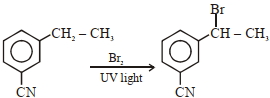
For the given reaction

${image}$
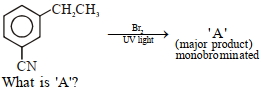
  • A

  • B


  • D

Answer

Correct option: C.

c

Need a full question paper?

Generate a complete, print-ready paper with questions like this in minutes — across 16+ boards, with answer keys.

Start Generating Free

Similar questions

Four alkali metals $A, B, C$ and  $D$ have standard electrode potentials $-3.05, -1.66, -0.40$ and $0.80\, V$ respectively. Which metal will be the most reactive
The equilibrium concentration of the species in the reaction $A + B \equiv C + D$ are $ 3, 5, 10$ and $15 $ $mole\,{L^{ - 1}}$ respectively at $300\,K$ the $\Delta G$ for the reaction is
For a certain reaction, the rate $=k[A]^2[B]$, when the initial concentration of $A$ is tripled keeping concentration of $B$ constant, the initial rate would
Two liquid $A$ and $B$ have $P_A^o$ and $P_B^o$ in the ratio of $1 : 3$ and the ratio of number of moles of $A$ and $B$ in liquid phase are $1 : 3$ then mole fraction of $'A'$ in vapour phase in equilibrium with the solution is equal to 
Which one of the following elements shows maximum number of different oxidation states in its compound 
The ground state energy of hydrogen atom is $-13.6 eV$. Consider an electronic state $\Psi$ of $He ^{-}$whose energy, azimuthal quantum number and magnetic quantum number are $-3.4 eV , 2$ and $0$ respectively. Which of the following statement($s$) is(are) true for the state $\Psi$ ?

$(1)$ It has $2$ angular nodes

$(2)$ It has $3$ radial nodes

$(3)$ It is a 4d state

$(4)$ The nuclear charge experienced by the electron in this state is less than $2 e$, where $e$ is the magnitude of the electronic charge.

Oxidation number of $C$ in $HNC$ is
The colligative properties of a solution depend on
How many .................. $\mathrm{gm}$ $\mathrm{KOH}$ grams  of caustic potash required to completely neutralise $12.6\, gm$ $HN{O_3}$
For the reaction $A + 2B \to C,$ rate is given by $R$ $ = [A]{[B]^2}$ then the order of the reaction is