MCQ
For the given reactions

$Sn ^{2+}+2 e ^{-} \rightarrow Sn$

$Sn ^{4+}+4 e ^{-} \rightarrow Sn$

The electrode potentials are; $E _{ Sn ^{2+} / Sn }^{\circ}=-0.140\, V$ and $E _{ Sn ^{4+} / Sn }^{\circ}=0.010\, V$. The magnitude of standard electrode potential for $Sn ^{4+} / Sn ^{2+}$ i.e. $E _{ Sn ^{4+} / Sn ^{2+}}^{\circ}$ is $.....\times 10^{-2}\, V$. (Nearest integer)

  • A
    $320$
  • B
    $32$
  • $16$
  • D
    $160$

Answer

Correct option: C.
$16$
c
$Sn ^{2+}+2 e ^{-} \rightarrow Sn \quad \Delta G _{1}^{0}=+2 \times 0.140 \times F$

$Sn ^{+4}+4 e ^{-} \rightarrow Sn \quad \Delta G _{2}^{0}=-4 \times 0.01 \times F$

____________________________________________

$Sn ^{+4}+2 e ^{-} \rightarrow Sn ^{+2} \quad \Delta G _{3}^{0}=-2 \times E _{ Sn ^{+4} / Sn ^{+2}}^{0} \times F$

$\Delta G _{3}^{0}=\Delta G _{2}^{0}-\Delta G _{1}^{0}$

$-2 \times E ^{0} \times F =-(0.04+0.28) \times F$

$E ^{0}=0.16$ volt $=16 \times 10^{-2} \,V$

Need a full question paper?

Generate a complete, print-ready paper with questions like this in minutes — across 16+ boards, with answer keys.

Start Generating Free

Similar questions

$n-$butane and isobutane are examples of
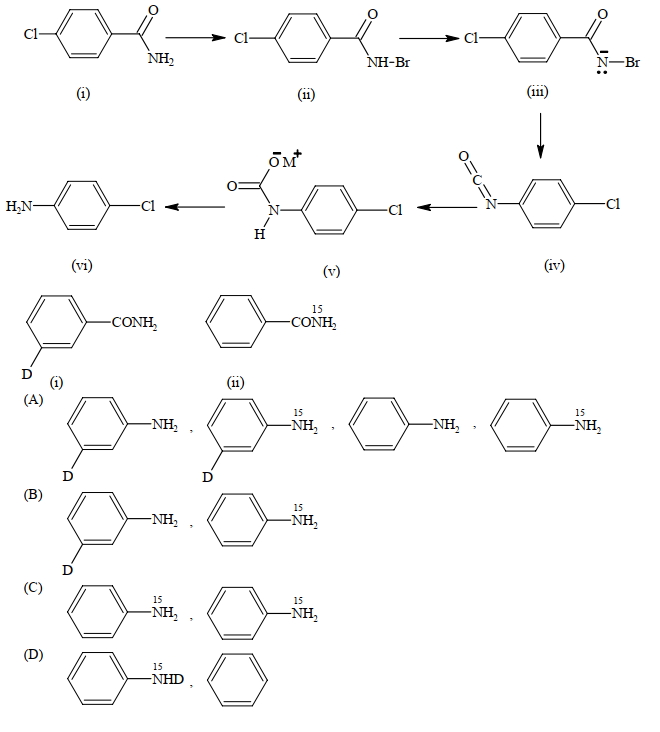
$\mathrm{RCONH}_2$ is converted into $\mathrm{RNH}_2$ by means of Hofmann bromamide degradation.

$Image$

In this reaction, $\mathrm{RCONHBr}$ is formed from which this reaction has derived its name. Electron donating group at phenyl activates the reaction. Hofmann degradation reaction is an intramolecular reaction.

$1.$  How can the conversion of $(i)$ to $(ii)$ be brought about?

$(A)$ $\mathrm{KBr}$  $(B)$ $\mathrm{KBr}+\mathrm{CH}_3 \mathrm{ONa}$  $(C)$ $\mathrm{KBr}+\mathrm{KOH}$  $(D)$ $\mathrm{Br}_2+\mathrm{KOH}$

$2.$  Which is the rate determining step in Hofmann bromamide degradation?

$(A)$ Formation of $(i)$  $(B)$ Formation of $(ii)$  $(C)$ Formation of $(iii)$  $(D)$ Formation of $(iv)$

$3.$  What are the constituent amines formed when the mixture of $(i)$ and $(ii)$ undergoes Hofmann bromamide degradation?

$Image$

give the answer question $1$, $2$, and $3.$

Assertion : According to transition state theory for the formation of an activated complex, one of the vibrational degree of freedom is converted into a translational degree of freedom.

Reason : Energy of the activated complex is higher than the energy of reactant molecules.

The number of possible resonance structures for $CO_3^{2 - }$is
The stepwise formation of $\left[ Cu \left( NH _{3}\right)_{4}\right]^{2+}$ is given below

$Cu ^{2+}+ NH _{3} \stackrel{ K _{1}}{\rightleftharpoons}\left[ Cu \left( NH _{3}\right)\right]^{2+}$

$\left[ Cu \left( NH _{3}\right)\right]^{2+}+ NH _{3} \stackrel{ K _{2}}{\rightleftharpoons}\left[ Cu \left( NH _{3}\right)_{2}\right]^{2+}$

$\left[ Cu \left( NH _{3}\right)_{2}\right]^{2+}+ NH _{3} \stackrel{ K _{3}}{\rightleftharpoons}\left[ Cu \left( NH _{3}\right)_{3}\right]^{2+}$

$\left[ Cu \left( NH _{3}\right)_{3}\right]^{2+}+ NH _{3} \stackrel{ K _{4}}{\rightleftharpoons}\left[ Cu \left( NH _{3}\right)_{4}\right]^{2+}$

The value of stability constants $K _{1}, K _{2}, K _{3}$ and $K _{4}$ are $10^{4}, 1.58 \times 10^{3}, 5 \times 10^{2}$ and $10^{2}$ respectively. The overall equilibrium constants for dissociation of $\left[ Cu \left( NH _{3}\right)_{4}\right]^{2+}$ is $x \times 10^{-12}$ The value of $x$ is ...............

(Rounded off to the nearest integer)
At room temperature solid paraffin is
In which of the following transition photon of maximum energy is absorbed
When zinc reacts with very dilute $HNO_3$, the oxidation state of nitrogen changes from
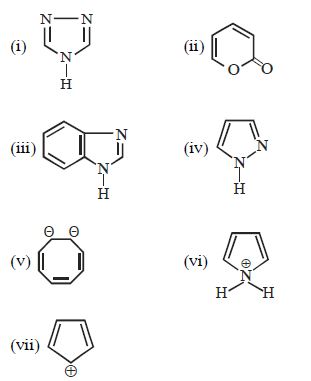
Identify the number of aromatic compounds
The oxidation number of cobalt in $K[Co{(CO)_4}]$ is