MCQ
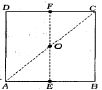
For the given uniform square lamina $ABCD$ , whose centre is $O$,
  • A
    $I_{AC}$ =$\sqrt 2 $$I_{EF}$
  • B
    $\sqrt 2 $$I_{AC}=I_{EF}$
  • C
    $I_{AO}=3I_{EF}$
  • $I_{AC}=I_{EF}$

Answer

Correct option: D.
$I_{AC}=I_{EF}$
d
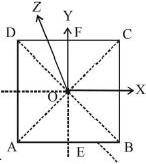
By the theorem of perpendicular axes,

${I_z} = {I_x} + {I_y}\,\,\,\,\,\,\,\,\,\,\,\,\,\,\,\,\,\,or,\,\,{I_z} = 2{I_y}$

$\begin{array}{l}
\left( {\,{I_x} = {I_y}\,by\,symmetry\,of\,the\,figure} \right)\\
\therefore \,{I_{EF}} = \frac{{{I_z}}}{2}\,\,\,\,\,\,\,\,\,\,\,\,\,\,\,\,\,\,\,\,\,\,\,\,\,\,\,\,\,\,\,\,\,\,\,\,\,...\left( i \right)
\end{array}$

Again, by the same theorem

$\begin{array}{l}
{I_z} = {I_{AC}} + {I_{BD}} = 2{I_{AC}}\\
\left( {\therefore \,{I_{AC}} = {I_{BD}}\,by\,symmetry\,of\,the\,figure} \right)\\
\,\,\,\,\,\,\,\,\,\,\,\,\,\,\,\therefore \,{I_{AC}} = \frac{{{I_z}}}{2}\,\,\,\,\,\,\,\,\,\,\,\,\,\,\,\,\,\,...\left( {ii} \right)
\end{array}$

    From $(i)$ and $(ii)$, we get ${I_{EF}} = {I_{AC}}$
Need a full question paper?

Generate a complete, print-ready paper with questions like this in minutes — across 16+ boards, with answer keys.

Start Generating Free

Similar questions

Two small conducting spheres of equal radius have charges $ + 10\,\mu C$ and $ - 20\,\mu C$ respectively and placed at a distance $R$ from each other experience force ${F_1}$. If they are brought in contact and separated to the same distance, they experience force ${F_2}$. The ratio of ${F_1}$ to ${F_2}$ is
A source of sound of frequency $256 Hz$ is moving rapidly towards a wall with a velocity of $5m/s$. The speed of sound is $330 m/s.$ If the observer is between the wall and the source, then beats per second heard will be .... $Hz$
Two non-reactive monoatomic ideal gases have their atomic masses in the ratio $2: 3$. The ratio of their partial pressures, when enclosed in a vessel kept at a constant temperature, is $4: 3$. The ratio of their densities is:
The magnetic flux linked to a circular coil of radius $R$ is :

$\phi=2 t^3+4 t^2+2 t+5 \;W b$

The magnitude of induced $emf$ in the coil at $t=5\; s$ is $..........\,V$.
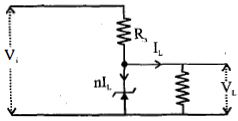
The value of the resistor, $R_S$, needed in the $dc$ voltage regulator circuit shown here, equals
A ring is rolling on an inclined plane. The ratio of the linear and rotational kinetic energies will be
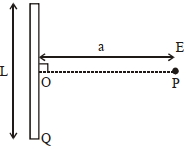
Find the electric field at point $P$ (as shown in figure) on the perpendicular bisector of a uniformly charged thin wire of length $L$ carrying a charge $Q.$ The distance of the point $P$ from the centre of the rod is $a=\frac{\sqrt{3}}{2} L$.
The wave described by $y=0.25 \,sin\left[ {10\pi x - 2\pi t} \right]$, where $x$ and $y$ are in meters and $t$ in seconds, is a wave travelling along the 
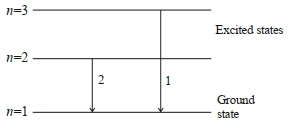
For hydrogen atom, $\lambda_1$ and $\lambda_2$ are the wavelengths corresponding to the transitions $1$ and $2$ respectively as shown in figure. The ratio of $\lambda_1$ and $\lambda_2$ is $\frac{x}{32}$. The value of $x$ is $..........$
The end product in the following sequence of reaction is

$HC \equiv CH\mathop {\xrightarrow{{{\text{1% HgS}}{{\text{O}}_{\text{4}}}}}}\limits_{20\% {H_2}S{O_4}} A\xrightarrow{{C{H_3}MgX}}B\xrightarrow{{[O]}}$