MCQ
For the hyperbola $\frac{{{x^2}}}{9} - \frac{{{y^2}}}{3} = 1$  the incorrect statement is :
  • A
    product of the perpendicular distances from any point on the hyperbola on its asymptotes is less than the length of its latus rectum .
  • B
    its eccentricity is $4/3$
  • C
    length of the latus rectum is $2$
  • both $(A)$ and $(B)$

Answer

Correct option: D.
both $(A)$ and $(B)$
d
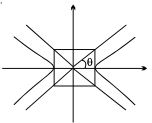
$p_1 p_2 = $ $\frac{{{a^2}\,{b^2}}}{{{a^2}\,\, + \,\,{b^2}}}$ ; $e = \sec \theta$ 
$e^2 =1 +\frac{9}{3}\,$ $= 4$  $ \Rightarrow $ $e = 2 = \sec\theta $ ($B$  is correct)
$\Rightarrow$ $\theta = 60°$
angle between the two asymptotes is $120°$ 
$\Rightarrow $ acute angle is $60°$ $ \Rightarrow $ $(A)$  is correct  
$C :$ $LLR =$ $\frac{{2{b^2}}}{a}\,$  = $2.\frac{3}{3}\,\,$ = $2 $ $\Rightarrow$  $(C)$ is correct  
$p_1p_2 $ = $\frac{{ab(\sec \theta  + \tan \theta )}}{{\sqrt {{a^2} + {b^2}} }}\,\,\,\frac{{ab(\sec \theta  - \tan \theta )}}{{\sqrt {{a^2} + {b^2}} }}$
$=$ $\frac{{{a^2}\,{b^2}}}{{{a^2} + {b^2}}}\,({\sec ^2}\theta  - {\tan ^2}\theta )\,\, = \,\,\frac{{9\,.\,3}}{{12}}\,\, = \,\,\,\frac{9}{4}\,$  

Need a full question paper?

Generate a complete, print-ready paper with questions like this in minutes — across 16+ boards, with answer keys.

Start Generating Free

Similar questions

The area of the region for which $0 < y < 3 - 2x - x^2\, \& \,x > 0$ is :
$\frac{{{1^3} + {2^3} + {3^3} + {4^3} + {{........12}^3}}}{{{1^2} + {2^2} + {3^2} + {4^2} + {{.........12}^2}}} = $
If $a$ and $c$ are positive real numbers and the ellipse $\frac{{{x^2}}}{{4{c^2}}} + \frac{{{y^2}}}{{{c^2}}} = 1$ has four distinct points in common with the circle $x^2 + y^2 = 9a^2$ , then
Three balls are drawn at random from a bag containing $5$ blue and $4$ yellow balls. Let the random variables $\mathrm{X}$ and $\mathrm{Y}$ respectively denote the number of blue and Yellow balls. If $\bar{X}$ and $\bar{Y}$ are the means of $X$ and $Y$ respectively, then $7 \bar{X}+4 \bar{Y}$ is equal to ..........
If $\sum_{ k =1}^{10} K ^{2}\left(10_{ C _{ K }}\right)^{2}=22000 L$, then $L$ is equal to $.....$
If $\mathop {\lim }\limits_{n \to \infty } \frac{{{1^a} + {2^a} + ....... + {n^a}}}{{{{\left( {n + 1} \right)}^{a - 1}}\left[ {\left( {na + 2} \right) + ......\left( {na + n} \right)} \right]}} = \frac{1}{{60}}$ for some positive real number $a$, then $a$ is equal to 
$\left| {\,\begin{array}{*{20}{c}}{1 + x}&1&1\\1&{1 + y}&1\\1&1&{1 + z}\end{array}\,} \right| = $
Consider the system of linear equation $x+y+z=$ $4 \mu, x+2 y+2 \lambda z=10 \mu, x+3 y+4 \lambda^2 z=\mu^2+15$, where $\lambda, \mu \in R$. Which one of the following statements is $NOT$ correct?
The sum of coefficients of integral power of $x$ in the binomial expansion ${\left( {1 - 2\sqrt x } \right)^{50}}$ is :
Let $H : \frac{ x ^{2}}{ a ^{2}}-\frac{y^{2}}{ b ^{2}}=1$, a $>0, b >0$, be a hyperbola such that the sum of lengths of the transverse and the conjugate axes is $4(2 \sqrt{2}+\sqrt{14})$. If the eccentricity $H$ is $\frac{\sqrt{11}}{2}$, then value of $a^{2}+b^{2}$ is equal to