Question
For the linear programming problem (LPP), the objective function is Z= 4x+3y and the feasible region determined by a set of constraints is shown in the graph:
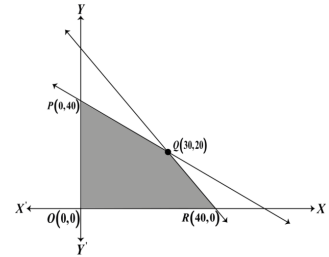
Image
Which of the following statements is true?

Answer

Corner point Value of the objective function Z = 4x + 3y
1. O(0, 0) z = 0
2. R(40, 0) z = 160
3. Q(30,20) z = 120 + 60 = 180
4. P(0,40) z = 120
Since, the feasible region is bounded so the maximum value of the objective function z = 180 is at Q(30, 20)

Need a full question paper?

Generate a complete, print-ready paper with questions like this in minutes — across 16+ boards, with answer keys.

Start Generating Free

Similar questions

If $A$ and $B$ are independent events such that $P ( A )=\frac{1}{5}, P ( A \cup B )=\frac{7}{10},$ then what is $P (\bar{B})$ equal to?
Refer to Question 18 maximum of Z occurs at:
If $A$ and $B$ are two independent events with $P(A)=\frac{1}{3}$ and $P(B)=\frac{1}{4}$, then $P\left(B^{\prime} \mid A\right)$ is equal to
For the following LPP, maximise $Z=3 x+4 y$ subject to constraints $x-y \geq-1, x \leq 3, x \geq 0, y \geq 0$, the maximum value is
The vectors $2\hat{\text{i}}+3\hat{\text{j}}-4\hat{\text{k}}$ and $\text{a}\hat{\text{i}}+\text{b}\hat{\text{j}}+\text{c}\hat{\text{k}}$ are perpendicular if:
  1. a = 2, b = 3, c = -4
  2. a = 4, b = 4, c = 5
  3. a = 4, b = 4, c = -5
  4. a = -4, b = 4, c = -5
Let $A=\left[\begin{array}{lll}a & 0 & 0 \\ 0 & a & 0 \\ 0 & 0 & a\end{array}\right]$, then $A^{ n }$ is equal to
Choose the correct answer from the given four options.
Corner points of the feasible region determined by the system of linear constraints are (0, 3), (1, 1) and (3, 0). Let Z = px + qy, where p, q > 0. Condition on p and q so that the minimum of Z occurs at (3, 0) and (1, 1) is:
  1. p = 2q
  2. $\text{p}=\frac{\text{q}}{2}$
  3. p = 3q
  4. p = q
The corner points of the feasible region determined by the system of linear constraints are (0, 10), (5, 5), (15, 15), (0, 20). Let Z = px + qy, where p, q > 0. Condition on p and q so that the maximum of Z occurs at both the points (15, 15) and (0, 20) is
If $AB = A$ and $BA = B,$ where $A$ and $B$ are square matrices, then:
Let $\text{y}=\sqrt{\sin\text{x}+\text{y}},$ then $\frac{\text{dy}}{\text{dx}}=$
  1. $\frac{\sin\text{x}}{2\text{y}-1}$
  2. $\frac{\sin\text{x}}{1-2\text{y}}$
  3. $\frac{\cos\text{x}}{1-2\text{y}}$
  4. $\frac{\cos\text{x}}{2\text{y}-1}$