MCQ
For the maximum height of a projectile
  • A
    horizontal component of velocity is zero.
  • vertical component of velocity is zero.
  • C
    vertical acceleration is zero.
  • D
    initial velocity should be zero.

Answer

Correct option: B.
vertical component of velocity is zero.
B

Need a full question paper?

Generate a complete, print-ready paper with questions like this in minutes — across 16+ boards, with answer keys.
Start Generating Free

Similar questions

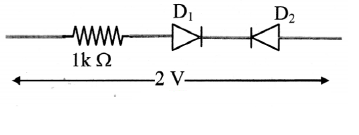
In the circuit shown below Di and D2 are two silicon diodes. The current in the circuit is …………….
Image
Which one of the following is WRONG?
An explosion breaks a rock into three parts in a horizontal plane. Two of them go off at right angles to each other. The first part of mass 1 kg moves with a speed of $12 m s ^{-1}$ and the second part of mass 2 kg moves with $8 m s ^{-1}$ speed. If the third part flies off with $4 m s ^{-1}$ speed, then its mass is
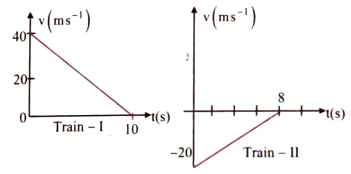
Two trains, which are moving along different tracks in opposite direction, are put on the same track by mistake. On noticing the mistake, when the trains are 300 m apart the drivers start slowing down the trains. The graphs given below show decrease in their velocities as function of time. The separation between the trains when both have stopped is
Image
The kinetic energy of a revolving satellite (mass $m$ ) at a height equal to thrice the radius of the earth (R) is
A proton of mass $1.6 \times 10^{-27}$ kg goes round in circular orbit of radius 0.10 m under a centripetal force of $4 \times 10^{-13} N$. Then the frequency of revolution of the proton is about
The charge on the electron is $1.6 \times 10^{-19} C.$ The number of electrons need to be removed from a metal sphere of $0.05 m$ radius so as to acquire a charge of $4 \times 10^{-15} C$ is
Two point charges of $+5 \mu C$ are so placed that they experience a force of $80 \times 10^{-3} N$. They are then moved apart, so that the force is now $2.0 \times 10^{-3} N$. The distance between them is now
A certain vector in the $y z$ plane has a $y$-component of $12 m$ and a $z$-component of $8 m$. It is then rotated in the $y z$ plane so that its $y$-component is halved. Then its new $z$-component is approximately
A satellite of mass ' $m$ ' is revolving in a circular orbit of radius ' $r$ ' round the earth. Its angular momentum w.r.t. the centre of its orbit is $(M=$ mass of earth, $G=$ universal gravitational constant)