MCQ
For the myopic eye, the defect is cured by
  • A
    Convex lens
  • Concave lens
  • C
    Cylindrical lens
  • D
    Toric lens

Answer

Correct option: B.
Concave lens
b
(b) In myopia, $u = \infty ,$ $v = d = $ distance of far point

By $ = \frac{{1}}{{f}} =  \frac{{1}}{{v}} -  \frac{{1}}{{u}},$ we get $f = - \;d$

Since $f$ is negative, hence the lens used is concave.

Need a full question paper?

Generate a complete, print-ready paper with questions like this in minutes — across 16+ boards, with answer keys.
Start Generating Free

Similar questions

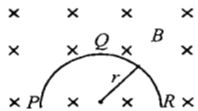
A thin semicircular conducting ring $(PQR)$ of radius $r$ is falling with its plane vertical in a horizontal magnetic field $B,$ as shown in the figure.The potential difference developed across the ring when its speed is $v,$ is 
Two ends of a conductor are at different temperatures the electromotive force generated between two ends is
Nearly $10 \%$ of the power of a $110\,W$ light bulb is converted to visible radiation. The change in average intensities of visible radiation, at a distance of $1\, m$ from the bulb to a distance of $5\,m$ is $a \times 10^{-2}\,W / m ^{2}$. The value of ' $a$ ' will be.
The electrons are emitted in the photoelectric effect from a metal surface
Two point charges $ + q$ and $ - q$ are held fixed at $( - d,\,0)$ and $(d,\,0)$ respectively of a $(X,\,Y)$ coordinate system. Then
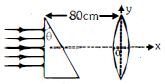
A parallel beam oflight is incident on a thin prism of prism angle of $\frac{4}{\pi }$ degrees. The refractive index of the prism is $1.5$. The focal length of the lens is $60\ cm$. The coordinates of converging point of the beam is
Ray optics is valid, when characteristic dimensions are
If $c $ is the speed of electromagnetic waves in vacuum, its speed in a medium of dielectric constant $K$ and relative permeability ${\mu _r}$ is
An electric dipole is kept in non-uniform electric field. It experiences
Assertion : Interference pattern is made by using blue light instead of red light, the fringes becomes narrower.
Reason : In Young’s double slit experiment, fringe width is given by relation $B = \frac{\lambda \mathrm{D}}{\mathrm{d}}$.