MCQ
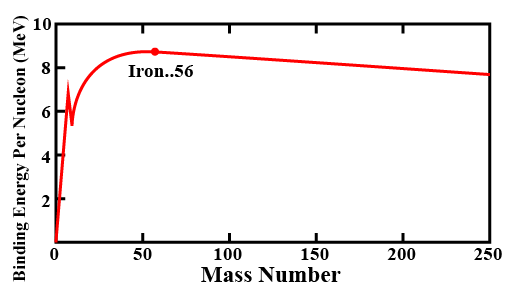
For the nuclie with mass number > 100:
  • A
    Binding energy of the nucleus decreases on an average as A increases.
  • B
    Binding energy of the nucleus increases on an average as A increases.
  • C
    The two nuclei fuse to form a bigger nuclide releasing energy.
  • D
    The nucleus essentially breaks up into two nuclides of equal mass releasing energy.
Answer

  1. Binding energy of the nucleus decreases on an average as A increases.

Explanation:

From the above figure it is clearly visible that the binding energy of the nucleus decreases on an average as A increases

Need a full question paper?

Generate a complete, print-ready paper with questions like this in minutes — across 16+ boards, with answer keys.

Start Generating Free

Similar questions

Figure represents two simple harmonic motions. The parameter which has different values in the two motions is:

  1. Amplitude.
  2. Frequency.
  3. Phase.
  4. Maximum velocity.
Which of the following does not fit into a group:

An alternating voltage of 141.4V (rms) is applied to a vacuum diode as shown in the figure. The maximum potential difference across the condenser will be

(a) 100 V

(b) 200 V

(c) 100 

(d) 200 

In case of a virtual and erect image, the magnification created by the mirror is:

A diminished image of an object is to be obtained on a screen 1.0 m from it. This can be achieved by appropriately placing

(a) A convex mirror of suitable focal length

(b) A concave mirror of suitable focal length

(c) A concave lens of suitable focal length

(d) A convex lens of suitable focal length less than 0.25 m

The value of emitted frequency is maximum, while transition of electron :

Dielectric constant of pure water is 81. Its permittivity will be

(a)   units

(b) 8.86  units

(c) 1.02  units

(d) Cannot be calculated

When the current through the electromagnet of a relay reaches a particular value.

Assertion  :  The air bubble shines in water.

Reason      : Air bubble in water shines due to refraction of light

(a) If both assertion and reason are true and the reason is the correct explanation of the assertion.

(b) If both assertion and reason are true but reason is not the correct explanation of the assertion.

(c) If assertion is true but reason is false.

(d) If the assertion and reason both are false.

Assertion   :   Anode of Coolidge tube gets heated up at time of emission of X-rays.

Reason      : The anode of Coolidge tube is made of a material of high melting point.

(a) If both assertion and reason are true and the reason is the correct explanation of the assertion.

(b) If both assertion and reason are true but reason is not the correct explanation of the assertion.

(c) If assertion is true but reason is false.

(d) If the assertion and reason both are false.