MCQ
For the reaction, the major product is formed by:
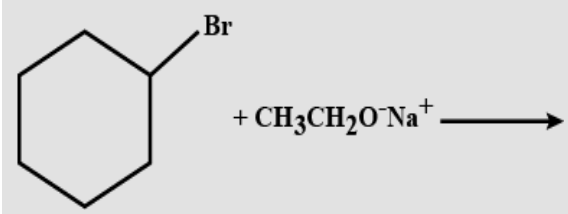
  • A
    An $E_1$ reaction
  • An $E_2$ reaction
  • C
    $S_{N_1}$ reaction
  • D
    $S_{N_2}$ reaction

Answer

Correct option: B.
An $E_2$ reaction
Since$, \ce{CH_3​CH_2​O}$ is a moderate base, so there is no possibility of $E_1$ reaction and in $\ce{E_1CB}$, there takes place the carbanion formation. Hex, there is no anion stabilising group, so $\ce{E_1CB}$ is not possible.
$E.$ mechanism is possible because of presence of $H -$atom anti to the leaving group $(Br).$

Need a full question paper?

Generate a complete, print-ready paper with questions like this in minutes — across 16+ boards, with answer keys.

Start Generating Free

Similar questions

When $9.45\, g$ of $ClCH _{2} COOH$ is added to $500$ $mL$ of water, its freezing point drops by $0.5^{\circ} C$. The dissociation constant of $ClCH _{2} COOH$ is $x \times 10^{-3}$. The value of $x$ is ...............

(Rounded off to the nearest integer)

$\left[ K _{ f \left( H _{2} O \right)}=1.86 \,K\, kg mol ^{-1}\right]$

Sodium thiosulphate is used to remove the unexposed $AgBr$ from photographic films by forming a complex. In this complex of silver, the coordination number of silver is
Consider the following complex : $[Co(NH_3)_5CO_3]ClO_4$ The coordination  number, oxidation number, no. of $d-$ electrons and number of unpaired $d-$ electrons  on the metal are respectively
Rate constant of reaction is $1.388 \times 10^{-3}\, mole^{-2}\,lit^{-2}\,sec^{-1}$ order of reaction will be
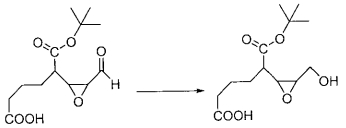
Reagent($s$) which can be used to bring about the following transformation is(are)

($A$) $\mathrm{LiAlH}_4$ in $\left(\mathrm{C}_2 \mathrm{H}_5\right)_2 \mathrm{O}$

($B$) $\mathrm{BH}_3$ in $THF$

($C$) $\mathrm{NaBH}_4$ in $\mathrm{C}_2 \mathrm{H}_5 \mathrm{OH}$

($D$) Raney $\mathrm{Ni} / \mathrm{H}_2$ in $\mathrm{THF}$
In electrochemical corrosion. the metal undergoing corrosion:
Which of the following compound will form $2^o -$ alcohol when treated with Grignard reagent followed by hydrolysis
Given below are two statements :

Statement $I :$ The nucleophilic addition of sodium hydrogen sulphite to an aldehyde or a ketone involves proton transfer to form a stable ion.

Statement $II :$ The nucleophilic addition of hydrogen cyanide to an aldehyde or a ketone yields amine as final product.

In the light of the above statements, choose the most appropriate answer from the options given below :
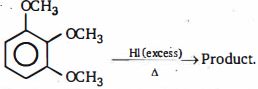
Predict major product of the above reaction is
The solubility of $AgCl$ will be maximum in which of the following?