MCQ
For the same speed, de Broglie wavelength.
- AOf electron is larger than proton
- BOf proton is larger than $\alpha$−particle
- COf electron is larger than $\alpha$−particle
- DAll of the above
Generate a complete, print-ready paper with questions like this in minutes — across 16+ boards, with answer keys.
The potential at a distance R/2 from the centre of a conducting sphere of radius R will be
|
(a) 0 |
(b) |
(c) |
(d) |
A heavy nucleus at rest breaks into two fragments which fly off with velocities in the ratio 8 : 1. The ratio of radii of the fragments is
|
(a) 1 : 2 |
(b) 1 : 4 |
(c) 4 : 1 |
(d) 2 : 1 |
Assertion : Blue colour of sky appears due to scattering of blue colour.
Reason : Blue colour has shortest wave length in visible spectrum.
|
(a) If both assertion and reason are true and the reason is the correct explanation of the assertion. |
|
(b) If both assertion and reason are true but reason is not the correct explanation of the assertion. |
|
(c) If assertion is true but reason is false. |
|
(d) If the assertion and reason both are false. |
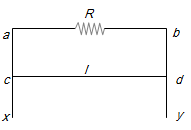
A wire cd of length l and mass m is sliding without friction on conducting rails ax and by as shown. The vertical rails are connected to each other with a resistance R between a and b. A uniform magnetic field B is applied perpendicular to the plane abcd such that cd moves with a constant velocity of
|
(a) |
(b) |
(c) |
(d) |
 absorbs an energetic neutron and emits beta particles. The resulting nucleus is
(a) 
|
(b) 
|
(c) 
|
(d) 
|
Given a point source of light, which of the following can produce a parallel beam of light
|
(a) Convex mirror |
|
(b) Concave mirror |
|
(c) Concave lens |
|
(d) Two plane mirrors inclined at an angle of 90° |


