MCQ
For the same total mass which of the following will have the largest moment of inertia about an axis passing through its centre of mass and perpendicular to the plane of the body
  • A
    a disc of radius $a$
  • B
    a ring of radius $a$
  • C
    a square lamina of side $2a$
  • four rods forming a square of side $2a$

Answer

Correct option: D.
four rods forming a square of side $2a$
d
$I_{d i s k}=\frac{m a^{2}}{2}$

$I_{\text {ring}}=m a^{2}$

$I_{s q \text { lamina }}=\frac{m(2 a)^{2}}{6}=\frac{2}{3} m a^{2}$

$I_{r o d}=$

$\left.I_{r o d}=I_{1}+I_{2} \text { [perpendicular axis theorem }\right]$

$I_{1}=\left(\frac{m}{4}\right) a^{2}+0 \rightarrow$ axis passing through centre of mass and parallel to axis

$I_{2}=\left(\frac{m}{4}\right) \frac{(2 a)^{2}}{12}$

$I_{r o d}=\left(\frac{m}{4}\right) a^{2}\left[1+\frac{1}{3}\right]=\frac{m a^{2}}{3}$

$I_{4 r o d}=4 I_{r o d}=\frac{4 m a^{2}}{3}$

largest moment of inertia is from rods forming a square of side $2 a .$
Need a full question paper?

Generate a complete, print-ready paper with questions like this in minutes — across 16+ boards, with answer keys.

Start Generating Free

Similar questions

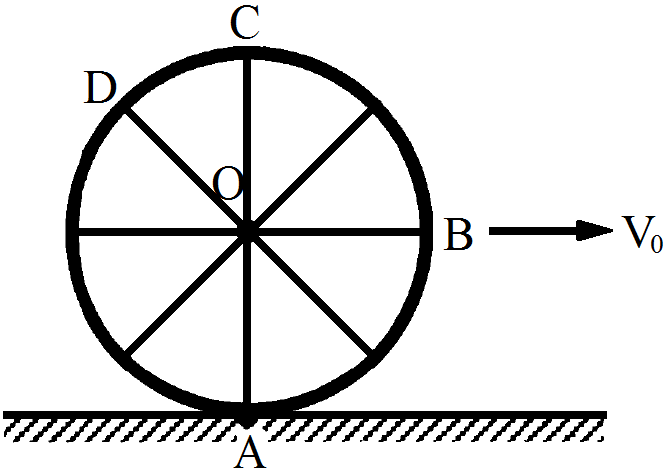
Consider a wheel of a bicycle rolling on a level road at a linear speed $v_0:$
A uniform rope of mass $6\,kg$ hangs vertically from a rigid support. A block of mass $2\,kg$ is attached to the free end of the rope. A transverse pulse of wavelength $0.06\,m$ is produced at the lower end of the rope. The wavelength of the pulse when it reaches the top is (in $m$ )
According to Newtonl's law of cooling, the rate of cooling is :
$A$ body $A$ is thrown vertically upwards with such a velocity that it reaches a maximum height of $h$. Simultaneously another body $B$ is dropped from height $h$. It strikes the ground and does not rebound. The velocity of $A$ relative to $B v/s$ time graph is best represented by : (upward direction is positive)
Consider the two statements related to circular motion in usual notations

$A$. In uniform circular motion $\vec{\omega}, \vec{v}$ and $\vec{a}$ are always mutually perpendicular

$B$. In non-uniform circular motion, $\vec{\omega}, \vec{v}$ and $\vec{a}$ are always mutually perpendicular

For the figure shown, when arc $ACD$ and $ADB$ are made of same material, the heat carried between $A$ and $B$ is $H$ . If $ADB$ is replaced with another material, the heat carried becomes $2H$ . If the temperatures at $A$ and $B$ are fixed at $T_1$ and $T_2$ , what is the ratio of the new conductivity to the old one of $ADB$
If three uniform spheres, each having mass $M$ and radius $r,$ are kept in such a way that each touches the other two, the magnitude of the gravitational force on any sphere due to the other two is:
The volume $V$ of a given mass of monoatomic gas changes with temperature $T$ according to the relation $V = KT ^{2 / 3}$. The workdone when temperature changes by $90\, K$ will be $x\,R$. The value of $x$ is $[ R =$ universal gas constant $]$
A body having volume $V$ and density $\rho$ is attached to the bottom of a container as shown. Density of the liquid is $d( > \rho )$. Container has a constant upward acceleration $a.$ Tension in the string is
The reason for the change in shape of a regular body is