Question
For the second period elements the correct increasing order of first ionisation enthalpy is

Answer

b
For same shell

$\left[s^{1} < p^{1} < s^{2} < p^{2} < p^{4} < p^{3} < p^{5} < p^{6}\right]$

$B < B e < C < O < N < F < N e$

Need a full question paper?

Generate a complete, print-ready paper with questions like this in minutes — across 16+ boards, with answer keys.
Start Generating Free

Similar questions

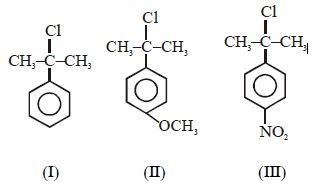
The decreasing order of reactivity of the compound given below towards solvolysis under identical condition is
The reaction (figure) is known as
Solid Lead nitrate is dissolved in $1\,litre$ of water. The solution was found to boil at $100.15^{\circ}\,C$. When $0.2\,mol$ of $NaCl$ is added to the resulting solution, it was observed that the solution froze at $-0.8^{\circ}\,C$. The solutbility product of $PbCl _2$ formed is $...........\times 10^{-6}$ at $298\,K$. (Nearest integer) Given : $K _{ b }=0.5\,K\,kg\,mol ^{-1}$ and $K _{ f }=1.8\,kg\,mol ^{-1}$. Assume molality to be equal to molarity in all cases.
Assign $A, B, C, D$ from given type of reaction. $Ag + PC{l_5}\xrightarrow{\Delta }AgCl + PC{l_3}$
The states of hybridazation of boron and oxygen atoms in boric acid $({H_3}B{O_3})$ are respectively
The normality of $4\%$ $(w/V)$ $NaOH$ is
Which one of the following statements concerning lanthanides elements is false
The structure of iron pentacarbonyl is:
$\begin{array}{*{20}{c}}
  {C{H_3} - C{H_2} - CH - C{H_3}\xrightarrow[{KOH}]{{Alc.}}\mathop X\limits_{\left( {{\text{major}}} \right)} \,;} \\ 
  {\,\,\,\,\,\,\,\,\,\,\,\,|\,\,\,\,\,\,\,\,\,\,\,\,\,\,\,\,\,\,\,\,\,\,\,\,\,\,\,\,\,\,\,} \\ 
  {\,\,\,\,\,\,\,\,\,\,\,\,\,Br\,\,\,\,\,\,\,\,\,\,\,\,\,\,\,\,\,\,\,\,\,\,\,\,\,\,\,\,\,} 
\end{array}\,$

$\begin{array}{*{20}{c}}
  {C{H_3} - C{H_2} - CH - C{H_3}\xrightarrow[\Delta ]{{EtoNa}}\mathop {{\text{ }}Y}\limits_{\left( {{\text{major}}} \right)} } \\ 
  {{\mkern 1mu} {\mkern 1mu} {\mkern 1mu} {\mkern 1mu} {\mkern 1mu} {\mkern 1mu} {\mkern 1mu} {\mkern 1mu} {\mkern 1mu} {\mkern 1mu} {\mkern 1mu} {\mkern 1mu} |{\mkern 1mu} {\mkern 1mu} {\mkern 1mu} {\mkern 1mu} {\mkern 1mu} {\mkern 1mu} \,\,\,\,\,{\mkern 1mu} \,\,\,\,{\mkern 1mu} {\mkern 1mu} {\mkern 1mu} {\mkern 1mu} {\mkern 1mu} {\mkern 1mu} {\mkern 1mu} {\mkern 1mu} {\mkern 1mu} {\mkern 1mu} {\mkern 1mu} {\mkern 1mu} {\mkern 1mu} {\mkern 1mu} {\mkern 1mu} {\mkern 1mu} {\mkern 1mu} {\mkern 1mu} {\mkern 1mu} {\mkern 1mu} {\mkern 1mu} {\mkern 1mu} {\mkern 1mu} {\mkern 1mu} } \\ 
  {{\mkern 1mu} {\mkern 1mu} {\mkern 1mu} \mathop {{\mkern 1mu} {\mkern 1mu} {\mkern 1mu} {\mkern 1mu} \,\,\,\,\,\,\,NM{e_3}\,\,\,\,\,\,\,{\mkern 1mu} }\limits_{\,\,\,\,\,\,\,\,\,\, \oplus \,\,\,\,\,\,\,\,\,\,\,\,\,\,\,\,\,\,\,\,} {\mkern 1mu} {\mkern 1mu} {\mkern 1mu} {\mkern 1mu} {\mkern 1mu} {\mkern 1mu} {\mkern 1mu} {\mkern 1mu} {\mkern 1mu} {\mkern 1mu} {\mkern 1mu} {\mkern 1mu} {\mkern 1mu} {\mkern 1mu} } 
\end{array}{\mkern 1mu} $

Product $(X)$ and $(Y)$ respectively is

Considering that $\Delta_{0}> P ,$ the magnetic moment (in $BM$) of $\left[ Ru \left( H _{2} O \right)_{6}\right]^{2+}$ would be