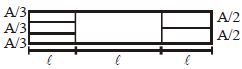
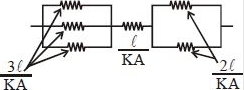
For the shown figure, calculate the equivalent thermal resistance if the bricks made of the same material of conductivity $K$
Medium
Download our app for free and get started
Total $-\frac{\ell}{K A}+\frac{\ell}{K A}+\frac{\ell}{K A}$

Download our appand get started for free
Experience the future of education. Simply download our apps or reach out to us for more information. Let's shape the future of learning together!No signup needed.*
Similar Questions
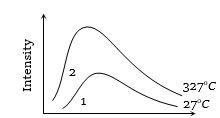
- 1The spectrum of a black body at two temperatures $27^oC$ and $327^oC$ is shown in the figure. Let $A_1$ and $A_2$ be the areas under the two curves respectively. The value of $\frac{{{A_2}}}{{{A_1}}}$ isView Solution
- 2A partition wall has two layers $A$ and $B$ in contact, each made of a different material. They have the same thickness but the thermal conductivity of layer $A$ is twice that of layer $B$. If the steady state temperature difference across the wall is $60K$, then the corresponding difference across the layer $A$ is ....... $K$View Solution
- 3The ratio of the diameters of two metallic rods of the same material is $2 : 1$ and their lengths are in the ratio $1 : 4$ . If the temperature difference between their ends are equal, the rate of flow of heat in them will be in the ratioView Solution
- 4Two sphere of radius $R_1$ and $R_2$ have densities ${\rho _1}$ and ${\rho _2}$ and specific heat $S_1$ and $S_2$ if they are heated to the same temperature the ratio of their rates of falling temperature will beView Solution
- 5The ends of two rods of different materials with their thermal conductivities, radii of cross-sections and lengths all are in the ratio $1:2$ are maintained at the same temperature difference. If the rate of flow of heat in the larger rod is $4\;cal/\sec $, that in the shorter rod in $cal/\sec $ will beView Solution
- 6A body of length 1m having cross sectional area $0.75\;m^2$ has heat flow through it at the rate of $ 6000\; Joule/sec$ . Then find the temperature difference if $K = 200\;J{m^{ - 1}}{K^{ - 1}}$ ...... $^oC$View Solution
- 7Heat is flowing through two cylindrical rods of the same material. The diameters of the rods are in the ratio $1 : 2$ and their lengths are in the ratio $2 : 1$. If the temperature difference between their ends is the same, then the ratio of the amounts of heat conducted through per unit time will beView Solution
- 8Assuming the sun to have a spherical outer surface of radius $r$, radiating like a black body at temperature $t^o C$, the power received by a unit surface, (normal to the incident rays) at a distance $R$ from the centre of the sun isView Solution
where $\sigma$ is the Stefan's constant.
- 9$Assertion :$ Bodies radiate heat at all temperature.View Solution
$Reason :$ Rate of radiation of heat is proportional to the fourth power of absolute temperature. - 10View SolutionRelation between the colour and the temperature of a star is given by