MCQ
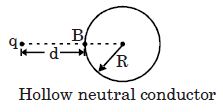
For the situation shown in the figure below, mark out the correct statement
  • A
    Potential of the conductor is $\frac{{ - q}}{{4\pi {\varepsilon _0}\left( {d + R} \right)}}$
  • B
    Potential of the conductor is $\frac{q}{{4\pi {\varepsilon _0}d}}$
  • C
    Potential of the conductor can’t be determined as nature of distribution of induced charges is not known
  • Potential at point $B$ due to induced charges is $\frac{{ - qR}}{{4\pi {\varepsilon _0}\left( {d + R} \right)d}}$
Answer

Correct option: D.
Potential at point $B$ due to induced charges is $\frac{{ - qR}}{{4\pi {\varepsilon _0}\left( {d + R} \right)d}}$
d
Potential at surface $=$ Potential at centre

$\mathrm{V}_{\mathrm{+q}}+\mathrm{V}_{\mathrm{ind}}=\mathrm{V}_{\mathrm{c}}$

$\mathrm{V}_{\mathrm{ind}}=\frac{\mathrm{Kq}}{(\mathrm{R}+\mathrm{d})}-\frac{\mathrm{Kq}}{\mathrm{d}}=\frac{-\mathrm{qR}}{4 \pi \varepsilon_{0}(\mathrm{d}+\mathrm{R}) \mathrm{d}}$

Need a full question paper?

Generate a complete, print-ready paper with questions like this in minutes — across 16+ boards, with answer keys.

Start Generating Free

Similar questions

In photo electric effect

$A.$ The photocurrent is proportional to the intensity of the incident radiation.

$B.$ Maximum Kinetic energy with which photoelectrons are emitted depends on the intensity of incident light.

$C.$ Max. $K.E$ with which photoelectrons are emitted depends on the frequency of incident light.

$D.$ The emission of photoelectrons require a minimum threshold intensity of incident radiation.

$E.$ Max. K.E of the photoelectrons is independent of the frequency of the incident light.

Choose the correct answer from the options given below:

A solid conducting sphere having a charge $Q$ is surrounded by an uncharged concentric conducting hollow spherical shell. Let the potential difference between the surface of the solid sphere and that of the outer surface of the hollow shell be $V$. If the shell is now given a charge of $-3Q$, the new potential difference between the same two surfaces is......$V$
The mean radius of the earth is $R$, its angular speed on its own axis is $\omega $ and the acceleration due to gravity at earth's surface is $g$. The cube of the radius of the orbit of a geostationary satellite will be
Two monochromatic light beams have intensities in the ratio 1:9. An interference pattern is obtained by these beams. The ratio of the intensities of maximum to minimum is
A particle moves in a circular path of radius $R$ with an angular velocity $\omega = a -bt$ where $a$ and $b$ are positive constants and $t$ is time. The magnitude of the acceleration of the particle after time $\frac {2a}{b}$ is
Two spherical conductors $A$ and $B$ of radius $a$ and $b (b > a)$ are placed in air concentrically $B$ is given charge $+ Q$ coulomb and $A$ is grounded. The equivalent capacitance of these is
A particle moves with simple harmonic motion in a straight line. In first $\tau  \,s$, after starting from rest, it travels a distance $a$, and in next $\tau \,s$, it travels $2a$ in same direction then
Two satellites revolve around a planet in coplanar circular orbits in anticlockwise direction. Their period of revolutions are $1\, hour$ and $8\, hours$ respectively. The radius of the orbit of nearer satellite is $2 \times 10^{3}\, {km}$. The angular speed of the farther satellite as observed from the nearer satellite at the instant when both the satellites are closest is $\frac{\pi}{{x}}\, {rad} \,{h}^{-1}$ where ${x}$ is ..... .
A $1.0\, kg$ ball drops vertically into a floor from a height of $25\, cm$. If rebounds to a height of $4\ cm$. The coefficient of restitution for the collision is
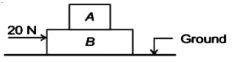
Blocks shown in figure moves with constant velocity $10 \,m / s$ towards right. All surfaces in contact are rough. The friction force applied by $B$ on $A$ is ...........$N$