MCQ
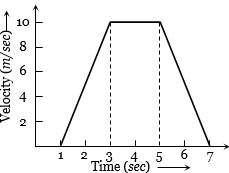
For the velocity-time graph shown in figure below the distance covered by the body in last two seconds of its motion is what fraction of the total distance covered by it in all the seven seconds
  • A
    $0.5$
  • $0.25$
  • C
    $0.33$
  • D
    $0.67$

Answer

Correct option: B.
$0.25$
b
(b)$\frac{{{{(S)}_{(last\;2s)}}}}{{{{(S)}_{7s}}}} = \frac{{\frac{1}{2} \times 2 \times 10}}{{\frac{1}{2} \times 2 \times 10 + 2 \times 10 + \frac{1}{2} \times 2 \times 10}} = \frac{1}{4}$

Need a full question paper?

Generate a complete, print-ready paper with questions like this in minutes — across 16+ boards, with answer keys.
Start Generating Free

Similar questions

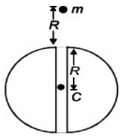
A particle of mass $m$ is dropped from a height $R$ equal to the radius of the earth above the tunnel dug through the earth as shown in the figure. Hence the correct statement is
Which of the following curves does not represent motion in one dimensions?
Calculate energy needed for moving a mass of $4\,\,kg$ from the centre of the earth to its surface (in joule), if radius of the earth is $6400\,\, km$ and acceleration due to gravity at the surface of the earth is $g = 10 \,\,m/sec^2.$
The mass and the diameter of a planet are three times the respective values for the Earth. The period of oscillation of a simple pendulum on the Earth is $2\,s$. The period of oscillation of the same pendulum on the planet would be
$16$ tunning forks are arranged in the order of increasing frequencies. Any two successive forks give $8$ beats per sec when sounded together. If the frequency of the last fork is twice the first, then the frequency of the first fork is
In figure, two blocks $M$ and $m$ are tied together with an inextensible and light string. The mass $M$ is placed on a rough horizontal surface with coefficient of friction $\mu$ and the mass $m$ is hanging vertically against a smooth vertical wall. The pulley is frictionless. When the downward acceleration of the elevator becomes equal to $g$, then
Two gases are said to be in thermal equilibrium when they have same
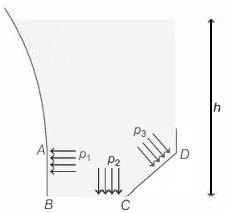
A tall tank filled with water has an irregular shape as shown. The wall $C D$ makes an angle of $45^{\circ}$ with the horizontal, the wall $A B$ is normal to the base $B C$. The lengths $A B$ and $C D$ are much smaller than the height $h$ of water (figure not to scale). Let $p_1, p_2$ and $p_3$ be the pressures exerted by the water on the wall $A B$, base $B C$ and the wall $C D$ respectively. Density of water is $\rho$ and $g$ is acceleration due to gravity. Then, approximately
A vehicle travels half the distance $L$ with speed $V_1$ and the other half with speed $V_2$​​​​​​​, then its average speed is:
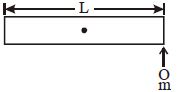
A stick of length $L$ and mass $M$ lies on a frictionless horizontal surface on which it is free to move in any ways. A ball of mass $m$ moving with speed $v$ collides elastically with the stick as shown in the figure. If after the collision the ball comes to rest, then what should be the mass of the ball ?