Question
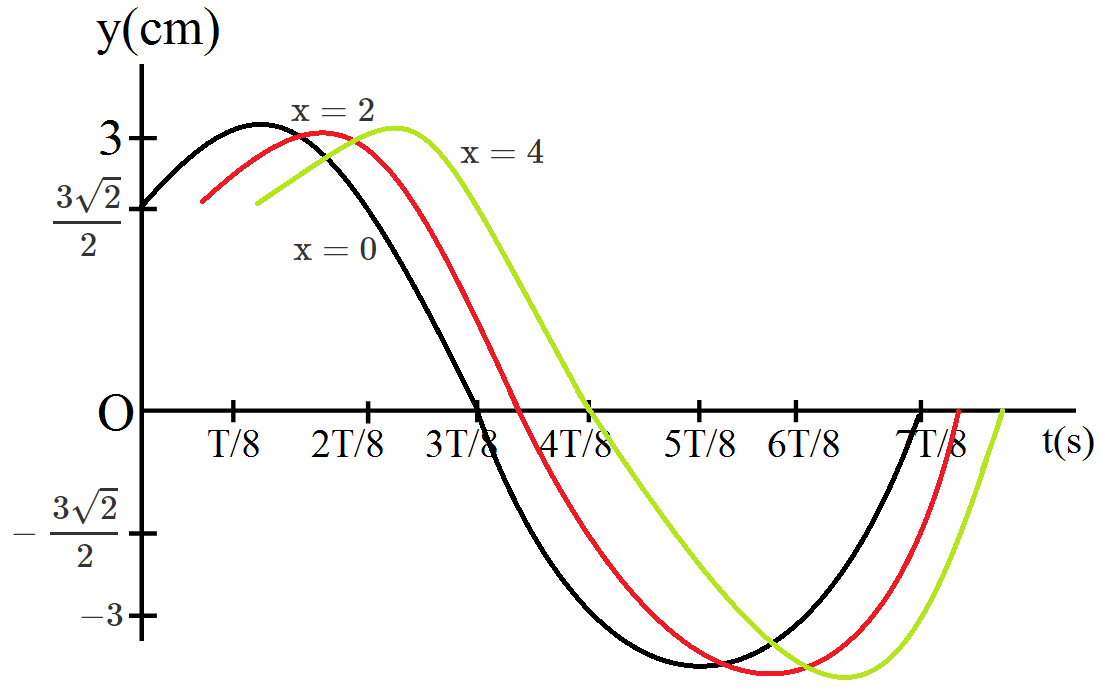
For the wave described in Exercise 15.8, plot the displacement (y) versus (t) graphs for x = 0, 2 and 4cm. What are the shapes of these graphs? In which aspects does the oscillatory motion in travelling wave differ from one point to another: amplitude, frequency or phase?
Answer

All the waves have different phases. The given transverse harmonic wave is: $\text{y}(\text{x, t})=3.0\sin\Big(36\text{t}+0.018\text{x}+\frac{\pi}{4}\Big)\ \dots(\text{i})$ For x = 0, the equation reduces to: $\text{y}(\text{x, t})3.0\sin\Big(36\text{t}+\frac{\pi}{4}\Big)$ Also, $\omega=\frac{2\pi}{\text{t}}=36\text{ rad/s}^{-1}$ $\therefore\ \text{t}=\frac{\pi}{18}\text{s}$ Now, plotting y vs. t graphs using the different values of t, as listed in the given table
t (s) 0 T/8 2T/7 3T/8 4T/8 5T/8 6T/8 7T/8
y (cm) $\frac{3}{\sqrt{2}}$ 3 $\frac{3}{\sqrt{2}}$ 0 $-\frac{3}{\sqrt{2}}$ –3 $-\frac{3}{\sqrt{2}}$ 0

Need a full question paper?

Generate a complete, print-ready paper with questions like this in minutes — across 16+ boards, with answer keys.

Start Generating Free

Similar questions

What is the gravitational potential and gravitational potential energy of a body of $0.2kg$ at a height $1600km$ above the surface of the earth? ($G= 6.67 \times 10^{-11}Nm^2kg^{-2}$, mass of the earth = $6 \times 10^{24}kg$ and radius of the earth = $6400km$).
The driver of a three-wheeler moving with a speed of 36km/h sees a child standing in the middle of the road and brings his vehicle to rest in 4.0s just in time to save the child. What is the average retarding force on the vehicle ? The mass of the three-wheeler is 400kg and the mass of the driver is 65kg.
A body describes simple harmonic motion with an amplitude of 5cm and a period of 0.2s. Find the acceleration and velocity of the body when the displacement is (a) 5cm (b) 3cm (c) 0cm.
Assume that the thermal conductivity of copper is four times that of brass. Two rods of copper and brass of the same length, and cross-section are joined end to end. The free end of the copper rod is kept at 0°C and the free end of the brass rod at 100°C. Calculate the temperature at the junction of the two rods at equilibrium. (Ignore radiation losses.)
Consider the situation shown in figure. The system is released from rest and the block of mass $1.0kg$ is found to have a speed $0.3m/s$ after it has descended through a distance of $1m$. Find the coefficient of kinetic friction between the block and the table.
You are riding in an automobile of mass $3000\  kg$. Assuming that you are examining the oscillation characteristics of its suspension system. The suspension sags $15\ cm$ when the entire automobile is placed on it. Also, the amplitude of oscillation decreases by $50\%$ during one complete oscillation. Estimate the values of $(a)$ the spring constant $k$ and $(b)$ the damping constant b for the spring and shock absorber system of one wheel, assuming that each wheel supports $750\ kg.$
Two discs of moments of inertia $I_1$ and $I_2$ about their respective axes (normal to the disc and passing through the centre), and rotating with angular speed $\omega_1$ and $\omega_2$ are brought into contact face to face with their axes of rotation coincident.
  1. Does the law of conservation of angular momentum apply to the situation? why?
  2. Find the angular speed of the two-disc system.
  3. Calculate the loss in kinetic energy of the system in the process.
  4. Account for this loss.
Two small balls, each of mass m are connected by a light rigid rod of length L. The system is suspended from its centre by a thin wire of torsional constant k. The rod is rotated about the wire through an angle $\theta_0$ and released. Find the tension in the rod' as the system passes through the mean position.
  1. What is the phenomenon of capillarity? Derive an expression for the rise of liquid in a capillary tube.
  2. What will happen if the length of the capillary tube is smaller than the height to which the liquid rises? Explain briefly.
Consider the situation shown in figure. The system is released from rest and the block of mass $1.0kg$ is found to have a speed $0.3m/s$ after it has descended through a distance of $1m$. Find the coefficient of kinetic friction between the block and the table.