Question
For two statements are given-one labelled Assertion (A) and the other labelled Reason (R). Select the correct answer to these questions from the codes (a), (b), (c) and (d) as given below.
  1. Both A and R are true, and R is the correct explanation of A.
  2. Both A and R are true, but R is not the correct explanation of A.
  3. A is true but R is false.
  4. A is false and R is also false.
Assertion (A): For charge to be in equilibrium, sum of the forces on charge due to rest of the two charges must be zero.
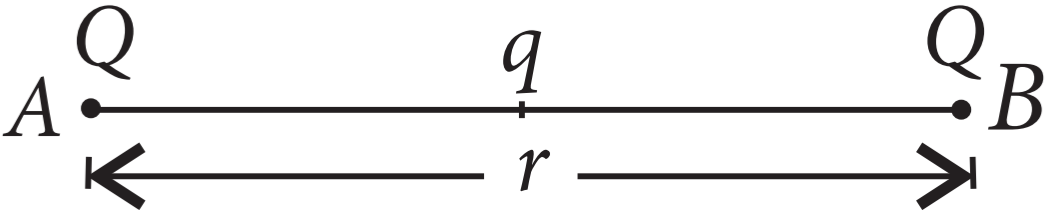
Reason (R): A charge is lying at the centre of the line joining two similar charges each which are fixed. The system will be in equilibrium if that charge is one fourth of the similar charges.
Answer

  1. A is true but R is false.

Explanation:

According to Coulomb's law, $\text{F}=\text{k}\frac{\text{Q}_1\text{Q}_2}{\text{r}^2}.$

The force on q due to A,

$\text{F}_\text{A}=\frac{1}{4\pi\in_0}\cdot\frac{\text{Qq}}{(\frac{\text{r}}{2})^2}$ to the right

Due to B,

$\text{F}_\text{B}=\frac{1}{4\pi\in_0}\cdot\frac{\text{Qq}}{(\frac{\text{r}}{2})^2}$ to the right

$\therefore$ Their sum is zero whether q is $+\frac{\text{Q}}{4}$or $-\frac{\text{Q}}{4}$ or any other value.

Therefore, it is not true that the third charge has to be $\frac{\text{Q}}{4}$ only. It can be any value.

Need a full question paper?

Generate a complete, print-ready paper with questions like this in minutes — across 16+ boards, with answer keys.

Start Generating Free

Similar questions

For two statements are given-one labelled Assertion (A) and the other labelled Reason (R). Select the correct answer to these questions from the codes (a), (b), (c) and (d) as given below.
  1. Both A and R are true, and R is the correct explanation of A.
  2. Both A and R are true, but R is not the correct explanation of A.
  3. A is true, but R is false.
  4. A is false, and R is also false.
Assertion (A): The dielectric constant for metals is infinity.
Reason (R): When a charged capacitor is filled completely with a metallic slab, its capacity becomes very large.
Two statements are given-one labelled Assertion (A) and the other labelled Reason (R). Select the correct answer to these questions from the codes (a), (b), (c) and (d) as given below.
  1. Both A and R are true and R is the correct explanation of A.
  2. Both A and R are true but R is NOT the correct explanation of A.
  3. A is true but R is false.
  4. A is false and R is also false.
Assertion (A): An ammeter is connected in series in the circuit.
Reason (R): An ammeter is a high resistance galvanometer.
Directions: In the following questions, the Assertions (A) and Reason(s) (R) have been put forward. Read both the statements carefully and choose the correct alternative from the following:
Assertion: Basic difference between an electric line and magnetic line of force is that former is discontinuous and the later is continuous or endless.
Reason: No electric lines of force exist inside a charged body but magnetic lines do exist inside a magnet.
  1. Both A and R are true and R is the correct explanation of A.
  2. Both A and R are true and R is not correct explanation of A.
  3. A is true, But R is false.
  4. A is false, But R is true.
Two statements are given-one labelled Assertion (A) and the other labelled Reason (R). Select the correct answer to these questions from the codes (a), (b), (c) and (d) as given below.
  1. Both A and R are true and R is the correct explanation of A.
  2. Both A and R are true but R is not the correct explanation of A.
  3. A is true but R is false.
  4. A is false and R is also false.
Assertion: The electric field and magnetic field have equal average values in linearly polarised plane em wave.
Reason: The electric energy and magnetic energy have equal average values in linearly polarised plane em wave.
For two statements are given-one labelled Assertion (A) and the other labelled Reason (R). Select the correct answer to these questions from the codes (a), (b), (c) and (d) as given below.
  1. Both A and R are true, and R is the correct explanation of A.
  2. Both A and R are true, but R is not the correct explanation of A.
  3. A is true, but R is false.
  4. A is false, and R is also false.
Assertion: Heater wire must have high resistance and high melting point.
Reason: If resistance is high, the electric conductivity will be less.
For question two statements are given-one labelled Assertion (A) and the other labelled Reason (R). Select the correct answer to these questions from the codes (a), (b), (c) and (d) as given below.
  1. Both A and R are true and R is the correct explanation of A.
  2. Both A and R are true but R is NOT the correct explanation of A.
  3. A is true but R is false.
  4. A is false and R is also false.
Assertion (A): In Young's double slit experiment the two slits are at distance d apart. Interference pattern is observed on a screen at distance D from the slits. At a point on the screen when it is directly opposite to one of the slits, a dark fringe is observed. Then the wavelength of wave is proportional to square of distance of two slits.
Reason (R): For a dark fringe intensity is zero.
For question, statements are given-one labelled Assertion (A) and the other labelled Reason (R). Select the correct answer to these questions from the codes (a) (b) (c) and (d) as given below.

  1. Both A and R are true, and R is the correct explanation of A.
  2. Both A and R are true, but R is NOT the correct explanation of A.
  3. A is true, but R is false.
  4. A is false and R is also false.
Assertion (A): Cadmium rods, used in a nuclear reactor, control the rate of fission.

Reason (R): Cadmium rods, used in a nuclear reactor, control the rate of fission.

For question, statements are given-one labelled Assertion (A) and the other labelled Reason (R). Select the correct answer to these questions from the codes (a) (b) (c) and (d) as given below.
  1. Both A and R are true, and R is the correct explanation of A.
  2. Both A and R are true, but R is NOT the correct explanation of A.
  3. A is true, but R is false.
  4. A is false and R is also false.
Assertion (A): Rydberg's constant varies with the mass number of a given element.
Reason (R): The reduced mass of the electron depends on the mass of the nucleus only.
Two statements are given-one labelled Assertion (A) and the other labelled Reason (R). Select the correct answer to these questions from thecodes(a), (b), (c) and (d) as given below.
  1. Both A and R are true and R is the correct explanation of A.
  2. Both A and R are true but R is not the correct explanation of A.
  3. A is true but R is false.
  4. A is false and R is also false.
Assertion: The resistivity of a semiconductor increases with temperature.
Reason: The atoms of a semiconductor vibrate with larger amplitude at higher temperatures thereby increasing its resistivity.
For two statements are given-one labelled Assertion (A) and the other labelled Reason (R). Select the correct answer to these questions from the codes (a), (b), (c) and (d) as given below.
  1. Both A and R are true, and R is the correct explanation of A.
  2. Both A and R are true, but R is not the correct explanation of A.
  3. A is true, but R is false.
  4. A is false, and R is also false.
Assertion: Though the same current flows through the live wires and the filament of the bulb but heat produced in the filament is much higher than that in live wires.
Reason: The filament of bulbs is made of a material of high resistance and high melting point.