MCQ
For two statements are given$-$one labelled Assertion and the other labelled Reason. Select the correct answer to these questions from the codes $(a), (b), (c)$ and $(d)$ as given below.
Assertion: In angiosperms, the first fertilization is called syngamy.
Reason: Second fertilization is called vegetative fertilization.
  • A
    Both assertion and reason are true, and reason is the correct explanation of assertion.
  • Both assertion and reason are true, but reason is not the correct explanation of assertion.
  • C
    Assertion is true, but reason is false.
  • D
    Both assertion and reason are false.

Answer

Correct option: B.
Both assertion and reason are true, but reason is not the correct explanation of assertion.
Fusion of the egg nucleus with sperm nucleus is called syngamy. As, in this process fusion product is diploid zygote or oospore, it is called generative fertilization. It is also called first fertilization as the first sperm fuses with the egg. The second male gamete fuses with the diploid secondary nucleus of the central cell to form a triploid primary endosperm cell. It is known as vegetative fertilization.

Need a full question paper?

Generate a complete, print-ready paper with questions like this in minutes — across 16+ boards, with answer keys.

Start Generating Free

Similar questions

For question two statements are given $-$ one labelled Assertion and the other labelled Reason. Select the correct answer to these questions from the codes $(a), (b), (c)$ and $(d)$ as given below.
Assertion : Indiscriminate exploitation ofeconomically important wild plants may lead to their extinction.
Reason : Non $-$ conservation of their germplasm is responsible for this.
For question two statements are given $-$ one labelled Assertion and the other labelled Reason. Select the correct answer to these questions from the codes $(a), (b), (c) $ and $(d)$ as given below.
Assertion : Generally the intraspecific competition is more intense than interspecific competition.
Reason : lntraspecific competition occurs when the resources are in short supply.
For two statements are given$-$one labelled Assertion and the other labelled Reason. Select the correct answer to these questions from the codes $(a), (b), (c)$ and $(d)$ as given below.
Assertion: Ubisch bodies are produced by glandular tape tum.
Reason: Ubisch bodies participated in the thickening of exine.
For question two statements are given $-$ one labelled Assertion and the other labelled Reason. Select the correct answer to these questions from the codes $(a), (b), (c)$ and $(d)$ as given below.
Assertion : Ectotherms are able to remain active under cold conditions.
Reason : Ectotherms are able to maintain a constant internal temperature, even when the temperature outside fluctuates.
Some multinational companies patent biological sample of other country without permission is called as :
Give the name of HGH (Human Growth Hormones), developed during recombinant DNA technology and used for treating hypopituitary dwarfism in human.
For question two statements are given-one labelled Assertion and the other labelled Reason. Select the correct answer to these questions from the codes $\text{(a), (b), (c)}$ and $(d)$ as given below.
Assertion: Epistasis does not show normal dihybrid ratio, i.e., $9 : 3 : 3 : 1$.
Reason: A gene suppresses the phenotypic expression of a non-allelic gene.
Read the following and answer any four questions from $(i)$ to $(v)$ given below:
A typical angiospermic ovule is a small structure attached to the placenta by means of a stalk called funicle. The body of the ovule fuses with funicle in the region called hilum. Each ovule has one or two protective envelopes called integuments. Integuments encircle the nucellus except at the tip where a small opening called the micropyle is formed. Mature ovules are classified on the basis of funiculus. It can be orthotropous, anadromous, hernitropous, campylotropous, etc.
  1. The body of the ovule consists of a mass of parenchymatous cells called:
  1. Integuments.
  2. Nucellus.
  3. Hilum.
  4. Funiculus.
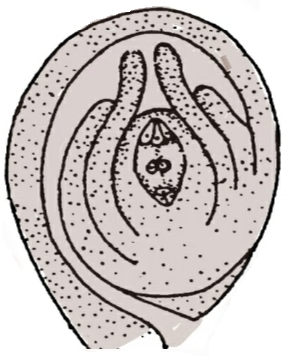
  1. Refer to the given figure and select the correct statement regarding it.
  1. This type of ovule is found in cactus.
  2. The micropyle comes to lie close to the funiculus due to unilateral growth of ovule.
  3. It is most common type of ovule found in the members of Chenopodiaceae.
  4. It is half inverted ovule.
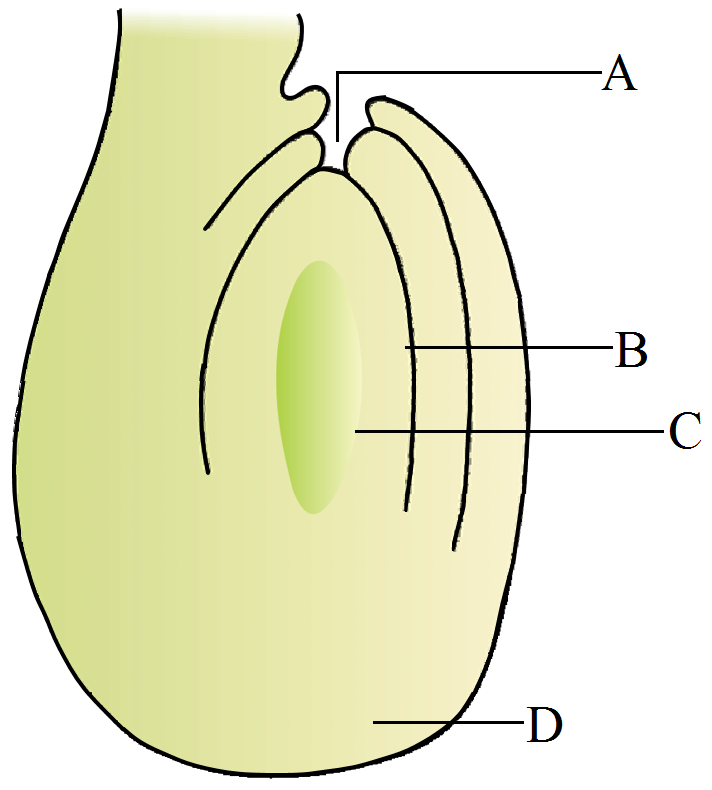
  1. Identify the parts labelled as $A, B, C$ and $D$ in the given figure and select the correct option.
S. No $A$ $B$ $C$ $D$
$(a)$ Chalaza Female gametophyte Embryo sac Micropyle
$(b)$ Chalaza NuceIIus Embryo sac Micropyle
$(c)$ Micropyle Egg Embryo sac Chalaza
$(d)$ Micropyle Nucellus Embryo sac Chalaza
  1. Mature ovules are classified on the basis of funiculus. If micropyle lie close to the funiculus, the ovule is termed as:
  1. Orthotropous.
  2. Anatropous.
  3. Hemitropous.
  4. Campylotropous.
  1. In Asphodel us, ovule is:
  1. Unitegmic.
  2. Tritegmic.
  3. Bitegmic.
  4. Ategmic.
For question, two statements are given$-$one labelled Assertion and the other labelled Reason. Select the correct answer to these questions from the codes $(a), (b), (c)$ and $(d)$ as given below.
Assertion: The genetic code is degenerate.
Reason : for a particular amino acid more than one codons can be used.
For question two statements are given $-$ one labelled Assertion and the other labelled Reason. Select the correct answer to these questions from the codes $(a), (b), (c)$ and $(d)$ as given below.
Assertion : Many endemic species are seen to flourish in sacred forests.
Reason : Sacred forests are undisturbed forest patches and biodiversity rich areas.