MCQ
For watt$-$less power in an $AC$ circuit the phase angle between the current and voltage is.
  • A
    $0^{\circ}$
  • $90^{\circ}$
  • C
    $45^{\circ}$
  • D
    Not possible

Answer

Correct option: B.
$90^{\circ}$

Watt$-$less power in an $AC$ circuit is basically power supposed to be generated by inductive and capacitive reactance and since they are not resistor they generate any heat, and these power wasted is called watt$-$less power and its phase angle is always $90^{\circ}$ as it has only capacitor and inductor.

Need a full question paper?

Generate a complete, print-ready paper with questions like this in minutes — across 16+ boards, with answer keys.

Start Generating Free

Similar questions

A metal rod of length $2\,m$ is rotating with an angular velocity of $100\, rad/sec$  in a plane perpendicular to a uniform magnetic field of $0.3 \,T$. The potential difference between the ends of the rod is.......$V$
If an electron jumps from 1st orbital to 3rd orbital, then it will
An electron having de-Broglie wavelength $\lambda$ is incident on a target in a X-ray tube. Cut-off wavelength of emitted $X$-ray is :
The specific resistance of a wire is ρ, its volume is 3 $M^3$ and its resistance is 3 ohms, then its length will be
A positive charge particle of $100 \,mg$ is thrown in opposite direction to a uniform electric field of strength $1 \times 10^{5} \,NC ^{-1}$. If the charge on the particle is $40 \,\mu C$ and the initial velocity is $200 \,ms ^{-1}$, how much distance (in $m$) it will travel before coming to the rest momentarily
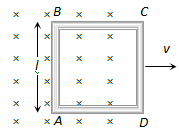
A conducting square loop of side l and resistance R moves in its plane with a uniform velocity v perpendicular to one of its sides. A magnetic induction B constant in time and space, pointing perpendicular and into the plane at the loop exists everywhere with half the loop outside the field, as shown in figure. The induced e.m.f. is
Force between the protons and neutrons in a nucleus is:
The impurity atom added to germanium to make it $N-$ type semiconductor is
Two identical p-ri junctions may be connected in series with a battery in three ways (figure). The potential difference across the two p-n. junctions are equal in:
The inward and outward electric flux for a closed surface in units of $N-m^2/C$ are respectively $8\times10^3$ and $4\times10^3$ Then the total charge inside the surface is [where $\varepsilon_0$ = permittivity constant]