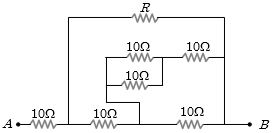
For what value of $R$ the net resistance of the circuit will be $18\, ohms$ ............... $\Omega$
Medium
Download our app for free and get started
(c) $R_{e q}=10+\frac{16 R}{16+R}$
$18=10+\frac{16 R}{16+R} \Rightarrow 8=\frac{16 R}{16+R}$
$128+8 R=16 R \Rightarrow 8 R=128$
$R=16 \Omega$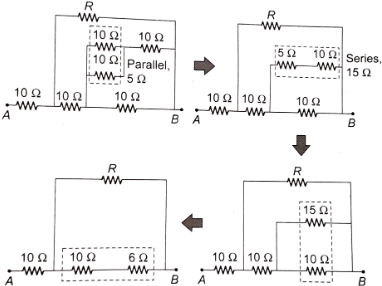

Download our appand get started for free
Experience the future of education. Simply download our apps or reach out to us for more information. Let's shape the future of learning together!No signup needed.*
Similar Questions
- 1Two cells, having the same $e.m.f.$ are connected in series through an external resistance $R.$ Cells have internal resistances $r_1$ and $r_2\,\, (r_1 > r_2)$ respectively. When the circuit is closed, the potential difference across the first cell is zero. The value of $R$ isView Solution
- 2View SolutionWhich is a wrong statement
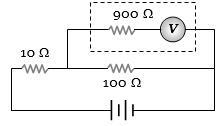
- 3The potential difference across the $100\,\Omega$ resistance in the following circuit is measured by a voltmeter of $900 \,\Omega$ resistance. The percentage error made in reading the potential difference isView Solution
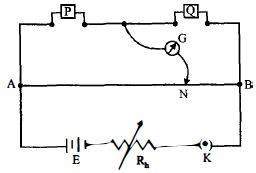
- 4In a meter bridge experiment resistances are connected as shown in the figure. Initially resistance $P\, = 4\,\Omega $ and the neutral point $N$ is at $60\,cm$ from $A$. Now an unknown resistance $R$ is connected in series to $P$ and the new position of the neutral point is at $80\,cm$ from $A$ . The value of unknown resistance $R$ isView Solution
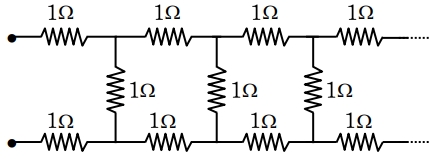
- 5View SolutionThe equivalent resistance of the infinite network given below is :
- 6View SolutionWhich is a wrong statement
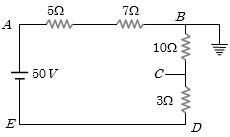
- 7In the circuit shown, the point ‘$B$’ is earthed. The potential at the point ‘$A$’ is ............. $V$View Solution
- 8Three resistances, each of $1\, ohm$, are joined in parallel. Three such combinations are put in series, then the resultant resistance will be ............. $ohm$View Solution
- 9Masses of three wires of copper are in the ratio of $1 : 3 : 5$ and their lengths are in the ratio of $5:3:1.$ The ratio of their electrical resistances areView Solution
- 10View SolutionThe positive temperature coefficient of resistance is for