MCQ
For which element would $XH_3$ be a stable species
  • A
    $C$
  • B
    $Si$
  • $P$
  • D
    $S$

Answer

Correct option: C.
$P$
c
$PH_3$ stable species.

Need a full question paper?

Generate a complete, print-ready paper with questions like this in minutes — across 16+ boards, with answer keys.
Start Generating Free

Similar questions

The pair having similar geometry is
In electrolysis, if the duration of the passage of current is doubled, the mass liberated is
$10\ gms$ . each of $CO_2$ , $NH_3$ and $O_2$ were taken in three separate flasks. What is the correct decreasing order of atoms
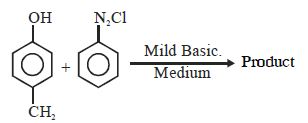
The main Product of following reaction will be
If the activation energy of a reaction is $80.9 \,kJ \,mol^{-1},$ the fraction of molecules at $700 \,K$, having enough energy to react to form products is $e ^{-x}$. The value of $x$ is ....... .
(Rounded off to the nearest integer) $\left[\right.$ Use $\left. R =8.31 \,J \,K ^{-1} \,mol ^{-1}\right]$
Match list $-I$ with list $-II$ and then select the correct answer from the codes given below that list

                                  List $-I$

$(A){\mkern 1mu} {\mkern 1mu} {\mkern 1mu} {C_6}{H_6} + CO + HCl\,\xrightarrow{{AlC{l_3}}}\,{C_6}{H_5}CHO$

$(B){\mkern 1mu} {\mkern 1mu} {\mkern 1mu} {C_6}{H_5} + C{H_3}$ $\xrightarrow{{Cr{O_2}C{l_2}}}\,{C_6}{H_5}CHO$

$(C){\mkern 1mu} {\mkern 1mu} {\mkern 1mu} {C_6}{H_5}C{H_2}Br\, + \,C{H_3}Br$ $\xrightarrow{{Na/ether}}\,{C_6}{H_5}C{H_2}C{H_3}$

$(D){\mkern 1mu} {\mkern 1mu} {\mkern 1mu} {C_6}{H_6}\, + \,{(C{H_3})_2}C = C{H_2}$ $\xrightarrow{{{H_2}S{O_4}}}\,{C_6}{H_5}C{(C{H_3})_3}$

                                 List $-II$
$(a)$   Friedel-Crafts reaction
$(b)$   Wurtz-Fitting reaction
$(c)$   Gattermann-Koch Aldehyde synthesis
$(d)$   Etard’s reaction

Select the odd structure out
The total number of monohalogenated organic products in the following (including stereoisomers) reaction is.........

$\begin{array}{*{20}{c}} A \\ {{\text{(simplest optically active alkene)}}} \end{array}\,\xrightarrow[{(ii)\,{X_2}/\Delta }]{{(i)\,{H_2}/Ni/\Delta }}$
In the conversion $B{r_2}\, \to \,BrO_3^ - ,$ the oxidation state of bromine changes from
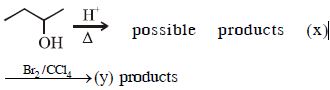
The number of possible products for $x$ and $y$ is