For which of the following the resistance decreases on increasing the temperature
Easy


Download our appand get started for free
Experience the future of education. Simply download our apps or reach out to us for more information. Let's shape the future of learning together!No signup needed.*
Similar Questions
- 1A $5\;ampere$ fuse wire can withstand a maximum power of $1\; watt$ in the circuit. The resistance of the fuse wire isView Solution
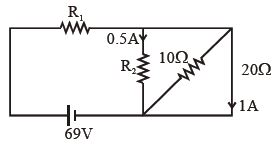
- 2In the circuit shown in the given figure the resistance $R_1$ and $R_2$ are respectivelyView Solution
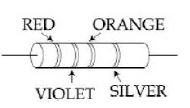
- 3View SolutionA resistance is shown in the figure. Its value and tolerance are given respectively by
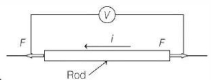
- 4As shown in the schematic below, a rod of uniform cross-sectional area $A$ and length $l$ is carrying a constant current $i$ through it and voltage across the rod is measured using an ideal voltmeter. The rod is stretched by the application of a force $F$. Which of the following graphs would show the variation in the voltage across the rod as function of the strain $\varepsilon$ when the strain is small. Neglect Joule heating.View Solution
- 5When a resistance of $2\, ohm$ is connected across the terminals of a cell, the current is $0.5\, A$. When the resistance is increased to $5\, ohm$, the current is $0.25\, A$. The $e.m.f.$ of the cell is ................. $V$View Solution
- 6Two bulbs are working in parallel order. Bulb $A$ is brighter than bulb $B$. If ${R_A}$ and ${R_B}$ are their resistance respectively thenView Solution
- 7Figure shows a part of an electric circuit. The potentials at points $a , b$ and $c$ are $30\,V , 12\,V$ and $2\,V$ respectively. The current through the $20 \Omega$ resistor will be $........\,A$View Solution
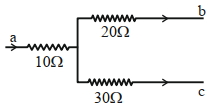
- 8Calculate the equivalent resistance between $A$ and $B$View Solution
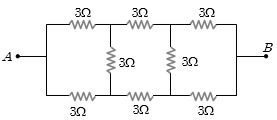
- 9A heating coil can heat the water of a vessel from $20\,^oC$ to $60\,^oC$ in $30$ minutes. Two such heating coils are put in series and then used to heat the same amount of water through the same temperature range. The time taken now will be ............ $min$ (neglecting thermal capacity of the coils)View Solution
- 10If the resistance of a conductor is $5\,\Omega\,\,$ at $\,50\,^oC$ and $7\, \Omega\,$ at $\,100\,^oC$ then the mean temperature coefficient of resistance of the material is ............... $^oC$View Solution