MCQ
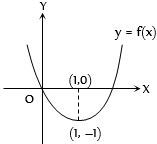
For which value of  $x$ , the function $f(x) = {x^2} - 2x$ is decreasing
  • A
    $x > 1$
  • B
    $x > 2$
  • $x < 1$
  • D
    $x < 2$

Answer

Correct option: C.
$x < 1$
c
(c) $f(x) = {(x - 1)^2} - 1$. Hence decreasing in $ x < 1.$

Aliter : $f'(x) = 2x - 2 = 2(x - 1)$

To be decreasing, $2(x - 1) < 0 \Rightarrow (x - 1) < 0 \Rightarrow x < 1$.
Need a full question paper?

Generate a complete, print-ready paper with questions like this in minutes — across 16+ boards, with answer keys.

Start Generating Free

Similar questions

Equations of the two straight lines passing through the point $(3, 2)$ and making an angle of ${45^o}$ with the line $x - 2y = 3,$ are
If $\mathop {\lim }\limits_{x \to 5} \frac{{{x^k} - {5^k}}}{{x - 5}} = 500$, then the positve integral value of $k$ is
Let $A = \left[ {\begin{array}{*{20}{c}}5&{5\alpha }&\alpha \\0&\alpha &{5\alpha }\\0&0&5\end{array}} \right]$, If ${\left| A \right|^2} = 25$, then $\left| \alpha \right|$ equals
If ${a_1},{a_2},....{a_n}$ are positive real numbers whose product is a fixed number $c$, then the minimum value of ${a_1} + {a_2} + ...$ $ + {a_{n - 1}} + 2{a_n}$ is
Tangents are drawn from the point $ (- 1, 2)$  on the parabola $y^2 = 4 x$. The length , these tangents will intercept on the line $x = 2 $ is :
If the sum of the coefficients in the expansion of $(x - 2y + 3 z)^n,$ $n \in N$ is $128$ then the greatest coefficie nt in the exp ansion of $(1 + x)^n$ is
Number of points where the function $f (x) = (x^2 - 1) | x^2 - x - 2 | + sin( | x | )$ is not differentiable, is
Let $a_1, a_2, \ldots \ldots, a_n$ be in A.P. If $a_5=2 a_3$ and $a_{11}=18$, then $12\left(\frac{1}{\sqrt{a_{10}}+\sqrt{a_{11}}}+\frac{1}{\sqrt{a_{11}}+\sqrt{a_{12}}}+\ldots . \cdot \frac{1}{\sqrt{a_{17}}+\sqrt{a_{18}}}\right)$ is equal to $..........$.
If $tan^{-1 } \frac{1}{1+2}+tan^{-1 } \frac{1}{1+(2)(3)}+ tan^{-1 }\frac{1}{1+(3)(4)}+$ ......$tan^{-1}\frac{1}{{1 + n(n + 1)}}=tan^{-1} \theta,$ then $\theta$ =
The points with position vectors $10\,i + 3\,j,\,\,12\,i - 5\,j$ and $a\,i + 11\,j$ are collinear, if $a = $