MCQ
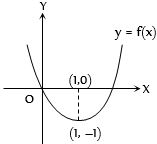
For which value of  $x$ , the function $f(x) = {x^2} - 2x$ is decreasing
  • A
    $x > 1$
  • B
    $x > 2$
  • $x < 1$
  • D
    $x < 2$

Answer

Correct option: C.
$x < 1$
c
(c) $f(x) = {(x - 1)^2} - 1$. Hence decreasing in $ x < 1.$

Aliter : $f'(x) = 2x - 2 = 2(x - 1)$

To be decreasing, $2(x - 1) < 0 \Rightarrow (x - 1) < 0 \Rightarrow x < 1$.
Need a full question paper?

Generate a complete, print-ready paper with questions like this in minutes — across 16+ boards, with answer keys.

Start Generating Free

Similar questions

The area of the region bounded by the curve $=2 x-x^2$ and the line $y = x$ is $........$ square units:
A company has two plants $\mathrm{A}$ and $\mathrm{B}$ to manufacture motorcycles. $60 \%$ motorcycles are manufactured at plant $\mathrm{A}$ and the remaining are manufactured at plant B. $80 \%$ of the motorcycles manufactured at plant $\mathrm{A}$ are rated of the standard quality, while $90 \%$ of the motorcycles manufactured at plant $B$ are rated of the standard quality. A motorcycle picked up randomly from the total production is found to be of the standard quality. If $p$ is the probability that it was manufactured at plant $\mathrm{B}$, then $126 \mathrm{p}$ is
If $X$ has a binomial distribution, $B( n, p)$ with parameters $n$ and $p$ such that $P(X\, = 2)\, = P (X\, = 3)$, then $E(X)$, the mean of variable $X$, is
if $x$ lies in the interval $[0,1]$, then the least value of $x^2+x+1$ is :
The integrating factor of the differential equation $\left(x+2 y^2\right) \frac{d y}{d x}=y(y>0)$ is :
The value of  $\mathop {n \to \infty }\limits^{\lim } \frac{1}{n}\sin \left( {\frac{1}{n}} \right){\left( {\cos \left( {\frac{1}{n}} \right)} \right)^2} $ $+ \frac{1}{n}\sin \left( {\frac{2}{n}} \right){\left( {\cos \left( {\frac{2}{n}} \right)} \right)^2} + \frac{1}{n}\sin \left( {\frac{3}{n}} \right){\left( {\cos \left( {\frac{3}{n}} \right)} \right)^2} +$ $ ..... + \frac{1}{n}(\sin 1){(\cos 1)^2}$ is 
$\int_{}^{} {\frac{{dx}}{{{{\sin }^2}x{{\cos }^2}x}} = } $
If $A$ and $ B$ are two square matrices such that $B = - {A^{ - 1}}BA$, then ${(A + B)^2} = $
The value of a for which the function $\text{f(x)}=\begin{cases}\frac{(4^\text{x}-1)^3}{\sin\Big(\frac{\text{x}}{\text{a}}\Big)\log\Big\{\Big(1+\frac{\text{x}^2}{3}\Big)\Big\}},&\text{x}\neq0\\12(\log4)^3,&\text{x}=0\end{cases}$ may be continuous at $x = 0$ is :
The maximum value of $\triangle=\begin{vmatrix}1&1&1\\1&1+\sin\theta&1\\1+\cos\theta&1&1\end{vmatrix}$ is $(\theta$ is real$):$