MCQ
Force between the two parallel wires carrying currents has been used to define:
- AAmpere
- BCoulomb
- CVolt
- DWatt
Explanation:
Ampere is defined as the constant current that will produce an attractive force of 2×10⁻⁷ newton per metre of length between two straight, parallel conductors (carrying the constant current) of infinite length and negligible circular cross section placed one metre apart in a vacuum. This is the Ampere's Force Law.
Generate a complete, print-ready paper with questions like this in minutes — across 16+ boards, with answer keys.
A planet of mass M has a satellite of mass m, revolving around the planet in a circular orbit of radius r and time period T. The mass (M) of the planet is
|
(a) |
(b) |
(c) |
(d) |
In the following figure, the magnet is moved towards the coil with a speed v and induced emf is e. If magnet and coil recede away from one another each moving with speed v, the induced emf in the coil will be
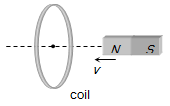
|
(a) e |
(b) 2e |
(c) e/2 |
(d) 4e |
Hubble's law states that the velocity with which the 'milky way' is moving away from the earth is proportional to
|
(a) Square of the distance of the milky way from the earth |
|
(b) Distance of milky way from the earth |
|
(c) Mass of the milky way |
|
(d) Product of the mass of the milky way and its distance from the earth |
In a transistor in CE configuration, the ratio of power gain to voltage gain is
|
(a) a |
(b) b / a |
(c) ba |
(d) b |


