Question
Form the pair of linear equations in the following problems, and find their solution graphically:
Champa went to a 'sale' to purchase some pants and skirts. When her friends asked her how many of each she had bought, she answered, "The number of skirts is two less than twice the number of pants purchased. Also the number of skirts is four less than four times the number of pants purchased." Help her friends to find how many pants and skirts Champa bought.
Answer

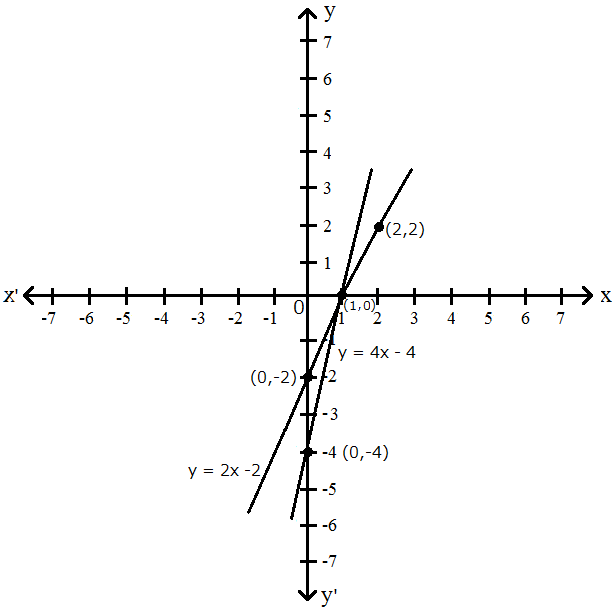
Let us denote the number of pants by x and the number of skirts by y. Then the equations formed are: y = 2x - 2 .....(i) y = 4x - 4 .......(ii) The graphs of the equations (i) and (ii) can be drawn by finding two solutions for each of the equations. They are given in the following table.
x
2
0
y = 2x - 2
2
-2
Hence, the graphic representation is as follows.
The two lines intersect at the point (1, 0). So, x = 1, y = 0 is the required solution of the pair of linear equations, i.e., the number of pants she purchased is 1 and she did not buy any skirt.

Need a full question paper?

Generate a complete, print-ready paper with questions like this in minutes — across 16+ boards, with answer keys.

Start Generating Free

Similar questions

∆AMT ~∆AHE, In ∆AMT, AM =6.3 cm
∠MAT= 120° , AT = 4.9 cm, $\frac{ AM }{ HA }=\frac{7}{5}$ then construct ∆AMT and ∆AHE .
$\triangle PQR \sim \triangle PAB , m \angle P =60^{\circ}, PQ =6 cm, PR =4 cm$. Construct $\triangle PAB$, if $PQ : PA =3: 2$.
If $\alpha,\ \beta,\ \gamma$ are the zeroes of the polynomial $p(x) = 6x^3 + 3x^2- 5x + 1$, find the value of $\Big(\frac{1}{\alpha}+\frac{1}{\beta}+\frac{1}{\gamma}\Big).$
A girls is twice as old as her sister. Four years hence, the product of their ages (in years) will be $160$. Find their present ages.
In the given figure, $\angle\text{ABC}=90^\circ$ and $\text{BD}\perp\text{AC}.$ If AB = 5.7cm, BD = 3.8cm, and CD = 5.4cm find BC.
Find the value of k for which root are real and equal in the following equations:
$kx^2 + kx + 1 = -4x^2 - x$
The $4^{th}$ term of an A.P. is three times the first and the $7^{th}$​​​​​​​ term exceeds twice the third term by $1$. Find the first term and the common difference.
For an A.P, t 17 = 54 and t 9 = 30 find the first term(a) and common difference(d).
Given below is the number of units of electricity consumed in a week in a certain locality:
Consumption (in units) 65-85 85-105 105-125 125-145 145-165 165-185 195-205
Number of consumers 4 5 13 20 14 7 4
Calculate the median
Write the expression $a_n - a_k$​​​​​​​ for the A.P. $a, a + d, a + 2d, ...$
Hence, find the common difference of the A.P. for which,
$20^{th}​​​​​​​$​​​​​​​ term is $10$ more than the $18^{th}​​​​​​​$​​​​​​​ term.