Forty electric bulbs are connected in series across a $220\, V$ supply. After one bulb is fused, the remaining $39$ are connected again in series across the same supply. The illumination will be
AIPMT 1989, Easy
Download our app for free and get started
(b) When $1$ bulb fuses, the total resistance of the circuit decreases hence the current increases. Since $P = {i^2}R$, therefore illumination increases.

Download our appand get started for free
Experience the future of education. Simply download our apps or reach out to us for more information. Let's shape the future of learning together!No signup needed.*
Similar Questions
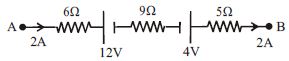
- 1The potential difference between $A$ and $B$ in the Figure is .............. $V$View Solution
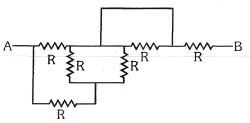
- 2What is the equivalent resistance between $A$ and $B$View Solution
- 3$A$ simple circuit contains an ideal battery and a resistance $R$. If a second resistor is placed in parallel with the first,View Solution
- 4A rod of length $l$ with thermally insulated lateral surface is made of a material whose thermal conductivity $K$ varies as $K = C/T$ , where $C$ is a constant. The ends are at temperatures $T_1$ and $T_2$ . The heat current density isView Solution
- 5What is the resistance of a carbon resistance which has bands of colours brown, black and brown .............. $\Omega$View Solution
- 6The charge flowing in a conductor changes with time as $Q ( t )=\alpha t -\beta t ^2+\gamma t ^3$. Where $\alpha, \beta$ and $\gamma$ are constants. Minimum value of current is :View Solution
- 7An electric bulb of $500 \,watt$ at $100\, volt$ is used in a circuit having a $200\, {V}$ supply. Calculate the resistance ${R}$ to be connected in series with the bulb so that the power delivered by the bulb is $500\, {W}$. (in $\Omega$)View Solution
- 8A $16\, \Omega$ wire is bend to form a square loop. A $9 \,{V}$ supply having internal resistance of $1 \,\Omega$ is connected across one of its sides. The potential drop across the diagonals of the square loop is $.......\,\times 10^{-1} \,{V}$View Solution
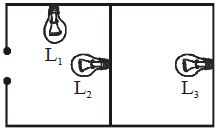
- 9Figure shows three similar lamps $L_1, L_2$ and $L_3$ connected across a power supply. If the lamp $L_3$ fuses, how will the light emitted by $L_1$ and $L_2$ change ?View Solution
- 10The potential difference between $A$ and $B$ in the Figure is ................. $V$View Solution
