Question
Four balls are to be drawn without replacement from a box containing 8 red and 4 white balls. If X denotes the number of red balls drawn, then find the probability distribution of X.

Answer

A, four balls are to be drawn without replacement and X denote the number of red balls drawn.
So, X is a random variable that can take values 0, 1, 2, 3 or 4.
Now,
P(X = 0) = P(All white balls) = P(WWWW) $=\frac{4}{12}\times\frac{3}{11}\times\frac{2}{10}\times\frac{1}{9}=\frac{1}{495},$
P(X = 1) = P(One of red balls and three white balls) = P(RWWW) + P(WRWW) + P(WWRW) + P(WWWR)
$=\frac{8}{12}\times\frac{4}{11}\times\frac{3}{10}\times\frac{2}{9}+\frac{4}{12}\times\frac{8}{11}\times\frac{3}{10}\times\frac{2}{9}+\frac{4}{12}\times\frac{3}{11}\times\frac{8}{10}\times\frac{2}{9}+\frac{4}{12}\times\frac{3}{11}\times\frac{2}{10}\times\frac{8}{9}$
$=4\times\frac{8}{495}=\frac{32}{495}.$
P(X = 2) = P(Two red balls and two white balls) = P(RRWW) + P(RWRW) + P(RWWR) + P(WWRR) + P(W
P(X = 3) = P(Three red balls and one white ball) = P(RRRW) + P(RRWR) + P(RWRR) + P(WRRR)
$=\frac{8}{12}\times\frac{7}{11}\times\frac{6}{10}\times\frac{4}{9}+\frac{8}{12}\times\frac{7}{11}\times\frac{4}{10}\times\frac{6}{9}+\frac{8}{12}\times\frac{4}{11}\times\frac{7}{10}\times\frac{6}{9}+\frac{4}{12}\times\frac{8}{11}\times\frac{7}{10}\times\frac{6}{9}$
$=4\times\frac{56}{495}=\frac{224 }{495}.$
P(X = 4) = P(All red balls) = P(RRRR) $=\frac{8}{12}\times\frac{7}{11}\times\frac{6}{10}\times\frac{5}{9}$
$=\frac{70}{495}$
So, the probability distribution of X is as follows:
$\text{X}$
$0$
$1$
$2$
$3$
$4$
$\text{P}(\text{X})$
$\frac{1}{495}$
$\frac{32}{495}$
$\frac{168}{495}$
$\frac{224}{495}$
$\frac{70}{495}$

Need a full question paper?

Generate a complete, print-ready paper with questions like this in minutes — across 16+ boards, with answer keys.
Start Generating Free

Similar questions

Prove that:
$\begin{vmatrix}(\text{b}+\text{c})^2&\text{a}^2&\text{bc}\\\text{c}+\text{a})^2&\text{b}^2&\text{ca} \\\text{a}+\text{b})^2&\text{c}^2&\text{ab}\end{vmatrix}$ $=(\text{a}-\text{b})(\text{b}-\text{c})(\text{c}-\text{b})(\text{a}+\text{b}+\text{c})(\text{a}^2+\text{b}^2+\text{c}^2)$
A gardener has supply of fertilizer of type I which consists of 10% nitrogen and 6% phosphoric acid and type II fertilizer which consists of 5% nitrogen and 10% phosphoric acid. After testing the soil conditions, he finds that he needs at least 14kg of nitrogen and 14kg of phosphoric acid for his crop. If the type I fertilizer costs 60 paise per kg and type II fertilizer costs 40 paise per kg, determine how many kilograms of each fertilizer should be used so that nutrient requirements are met at a minimum cost. What is the minimum cost?
If $\text{y}=\log\frac{\text{x}^2+\text{x}+1}{\text{x}^2-\text{x}+1}+\frac{2}{\sqrt{3}}\tan^{-1}\Big(\frac{\sqrt{3}\text{x}}{1-\text{x}^2}\Big),$ find $\frac{\text{dy}}{\text{dx}}$
A pair of fair dice is thrown. Let X be the random variable which denotes the minimum of the two numbers which appear. Find the probability distribution, mean and variance of X.
Find the vector and cartesian equations of the line passing through the point (2, 1, 3) and perpendicular to the lines$\frac{\text{x}-1}{1}=\frac{\text{y}-2}{2}=\frac{\text{z}-3}{3}$ and$\frac{\text{x}}{-3}=\frac{\text{y}}{2}=\frac{\text{z}}{5}.$
Solve the following differential equations:
$\text{x}\frac{\text{dy}}{\text{dx}}=\text{x + y}$
Solve the following systems of homogeneous linear equations by matrix method: $x + y - z = 0 , x - 2y + z = 0a , 3x + 6y - 5z = 0$
Evaluate the following integrals:
$\int\limits_{0}^{2}\text{x}\sqrt{\text{x}+2}\text{ dx}$
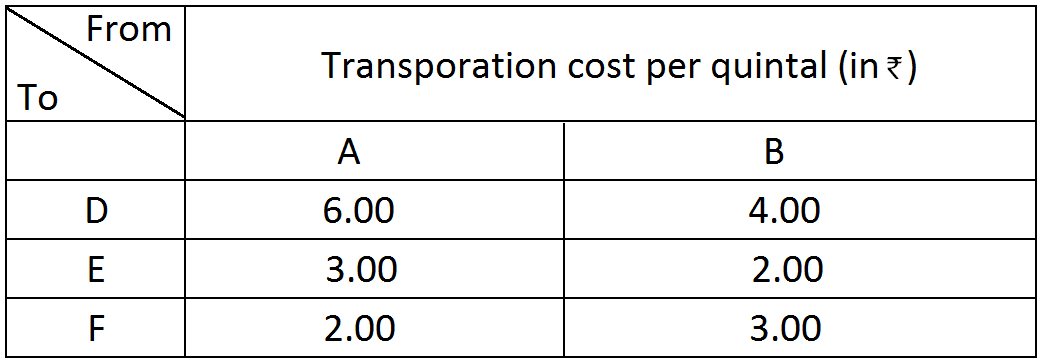
Tow godowns$, A$ and $B,$ have grain storage capacity of $100$ quintals and $50$ quintals respectively. They supply to $3$ ration shops, $D, E$ and $F,$ whose requirements are $60, 50$ and $40$ quintals respectively. The cost of transportation per quintal from the godowns to the shops are given in the following table:
How should the supplies be transported in order that the transportation cost is minimum? 
Evaluate the following integrals:
$\int\frac{1}{(\text{x}^2+2\text{x}+10)^2}\text{ dx}$