MCQ
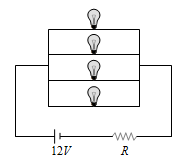
Four identical electrical lamps are labelled $1.5V, 0.5A$ which describes the condition necessary for them to operate at normal brightness. A $12V$ battery of negligible internal resistance is connected to lamps as shown, then
  • A
    The value of $R$ for normal brightness of each lamp is $(3 / 4) \Omega$
  • The value of $R$ for normal brightness of each lamp is $(21 / 4) \Omega$
  • C
    Total power dissipated in circuit when all lamps are normally bright is $24 W$
  • D
    Power dissipated in $R$ is $21 W$ when all lamps are normally bright

Answer

Correct option: B.
The value of $R$ for normal brightness of each lamp is $(21 / 4) \Omega$

Need a full question paper?

Generate a complete, print-ready paper with questions like this in minutes — across 16+ boards, with answer keys.

Start Generating Free

Similar questions

The relation between the linear magnification $m,$ the object distance $u$ and the focal length $f$ is
Point charges $+4 q,-q$ and $+4 q$ are kept on the $X$-axis at points $x=0, x=a$ and $x=2$ a respectively:
What percentage of original radioactive atoms is left after five half lives(a) 0.3%(b) 1%(c) 31%(d) 3.125%
       
The electrical circuits used to get smooth d.c. output from a rectifier circuit is called(a) Filter(b) Amplifier(c) Full wave rectifier(d) Oscillator
       
An under water swimmer is at a depth of 12 m below the surface of water.  A bird is at a height of 18 m from the surface of water, directly above his eyes.  For the swimmer the bird appears to be at a distance from the surface of water equal to (Refractive Index of water is 4/3)(a) 24 m   (b) 12 m(c) 18 m(d) 9 m
       
A block $A$ kept on an inclined surface just begins to slide if the inclination is $30^\circ$ . The block is replaced by another block $B$ and it is found that it just begins to slide if the inclination is $40^\circ$ :
  1. Mass of $A >$ mass of $ B$.
  2. Mass of $A <$ mass of $B$.
  3. Mass of $A =$ mass of $B.$
  4. All the three are possible.
A point charge of 40 stat coulomb is placed 2 cm in front of an earthed metallic plane plate of large size. Then the force of attraction on the point charge is(a) 100 dynes(b) 160 dynes(c) 1600 dynes(d) 400 dynes
       
You lift a suitcase from the floor and keep it on a table. The work done by you on the suitcase does not depend on:
  1. The path taken by the suitcase.
  2. The time taken by you in doing so.
  3. The weight of the suitcase.
  4. Your weight.
When an object possess electric charge then the object is said to be:
A thermo couple develops 200μV between 0℃  and 100℃. If it develops 64μV  and 76μV  respectively between (0℃ - 32℃)  and (32℃ - 70℃) then what will be the thermo emf it develops between 70℃  and 100℃ (a) 65 μV(b) 60 μV(c) 55 μV   (d) 50 μV