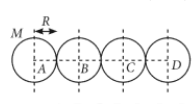
(b) : Use parallel axis theorem, $ \begin{aligned} & I_A=\frac{2}{5} M R^2+\left(\frac{2}{5}+4\right) M R^2+\left(\frac{2}{5}+16\right) M R^2+\left(\frac{2}{5}+36\right) M R^2 \\ & I_A=\left(4 \times \frac{2}{5}+56\right) M R^2 \\ & I_B=\left(\frac{2}{5}+4\right) M R^2+\frac{2}{5} M R^2+\left(\frac{2}{5}+4\right) M R^2+\left(\frac{2}{5}+16\right) M R^2 \\ & I_B=\left(2 \times \frac{4}{5}+24\right) M R^2 \end{aligned} $ Now, $I_A-I_B=(56-24) M R^2=32 M R^2$
Need a full question paper?
Generate a complete, print-ready paper with questions like this in minutes — across 16+ boards, with answer keys.