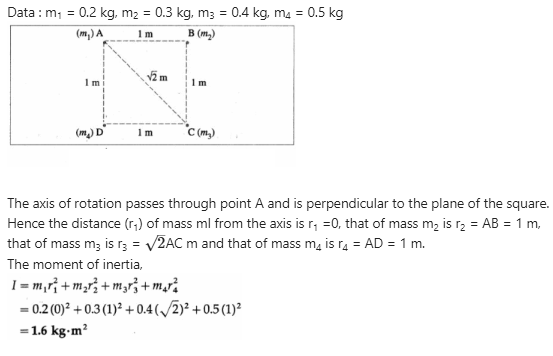
Four particles of masses 0.2 kg, 0.3 kg, 0.4 kg and 0.5 kg respectively are kept at comers A, B, C and D of a square ABCD of side 1 m. Find the moment of inertia of the system about an axis passing through point A and perpendicular to the plane of the square.
Q 66.1
Download our app for free and get started

Download our appand get started for free
Experience the future of education. Simply download our apps or reach out to us for more information. Let's shape the future of learning together!No signup needed.*
Similar Questions
- 1A torque of $20 \mathrm{~N}$.m sets a stationary circular disc into rotation about a transverse axis through its centre and acts for $2 \pi$ seconds. If the disc has a mass $10 \mathrm{~kg}$ and radius $0.2 \mathrm{~m}$, what is its frequency of rotation after $2 \pi$ seconds ?View Solution
- 2View SolutionUsing the energy conservation, derive the expressions for the minimum speeds at different locations along a vertical circular motion controlled by gravity. Is zero speed possible at the uppermost point? Under what condition/s? Also prove that the difference between the extreme tensions (or normal forces) depends only upon the weight of the object.
- 3A lawn roller of mass $80 \mathrm{~kg}$, radius $0.3 \mathrm{~m}$ and moment of inertia $3.6 \mathrm{~kg} \cdot \mathrm{m}^2$, is drawn along a level surface at a constant speed of $1.8 \mathrm{~m} / \mathrm{s}$. FindView Solution
(i) the translational kinetic energy
(ii) the rotational kinetic energy
(iii) the total kinetic energy of the roller. - 4View SolutionExpress the kinetic energy of a rotating body in terms of its angular momentum.
- 5Given the moment of inertia of a thin uniform disc about its diameter to be $\frac{1}{4} M R^2$, where $M$ and $R$ are respectively the mass and radius of the disc, find its moment of inertia about an axis normal to the disc and passing through a point on its edge.View Solution
- 6View SolutionA uniform disc and a hollow right circular cone have the same formula for their M.I., when rotating about their central axes. Why is it so?
- 7A torque of $100 \mathrm{~N} . \mathrm{m}$ is applied to a body capable of rotating about a given axis. If the body starts from rest and acquires kinetic energy of $10000 \mathrm{~J}$ in 10 seconds, findView Solution
(i) its moment of inertia about the given axis
(ii) its angular momentum at the end of 10 seconds. - 8A wheel of moment of inertia $1 \mathrm{~kg} \cdot \mathrm{m}^2$ is rotating at a speed of $40 \mathrm{rad} / \mathrm{s}$. Due to the friction on the axis, the wheel comes to rest in 10 minutes. Calculate the angular momentum of the wheel, two minutes before it comes to rest.View Solution
- 9A stone of mass $1 \mathrm{~kg}$, attached at the end of a $1 \mathrm{~m}$ long string, is whirled in a horizontal circle. If the string makes an angle of $30^{\circ}$ with the vertical, calculate the centripetal force acting on the stone.View Solution
- 10View SolutionOn what factors does the frequency of a conical pendulum depend? Is it independent of some factors?