MCQ
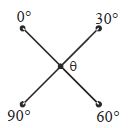
Four rods of same material and having the same cross section and length have been joined, as shown. The temperature of junction of four rods will be........ $^oC$
  • A
    $20$
  • B
    $30$
  • $45$
  • D
    $60$

Answer

Correct option: C.
$45$
c
$\frac{{{\rm{KA}}(90 - \theta )}}{l} = \frac{{{\rm{KA}}(\theta  - 30)}}{l} + \frac{{{\rm{KA}}(\theta  - {\rm{0}})}}{l} + \frac{{{\rm{KA}}(\theta  - 60)}}{l}$

$90-\theta=3 \theta-90^{\circ}$

$\theta=45^{\circ}$ $C$

Need a full question paper?

Generate a complete, print-ready paper with questions like this in minutes — across 16+ boards, with answer keys.
Start Generating Free

Similar questions

Two wires of the same material and length but diameter in the ratio 1 : 2 are stretched by the same load. The ratio of elastic potential energy per unit volume for the two wires is:
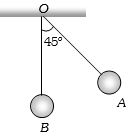
The bob $A$ of a simple pendulum is released when the string makes an angle of ${45^o}$with the vertical. It hits another bob $B$ of the same material and same mass kept at rest on the table. If the collision is elastic
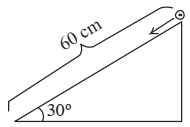
A solid cylinder is released from rest from the top of an inclined plane of inclination $30^{\circ}$ and length $60\,cm$. If the cylinder rolls without slipping, its speed upon reaching the bottom of the inclined plane is $...........ms ^{-1}$. (Given $g =10\,ms ^{-2}$)
A small ball of mass $m$ and density $\rho$ is dropped in a viscous liquid of density $\rho_0$. After sometime, the ball falls with constant velocity. The viscous force on the ball is:
Displacement current goes through the gap between the plates of a capacitor when the charge of the capacitor:
  1. Increases.
  2. Decreases.
  3. Does not change.
  4. Is zero.
An ideal gas is made to undergo the cyclic process shown in the figure below. Let $\Delta W$ depict the work done, $\Delta U$ be the change in internal energy of the gas and $Q$ be the heat added to the gas. Sign of each of these three quantities for the whole cycle will be (0 refers to no change)
There is a following relationship between the distance covered $x$ and time $t$ of a particle is : $x=\mathrm{At}+\mathrm{Bt}^2$. In this dimensions of A and B are :
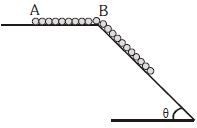
$A$ chain of length $L$ and mass $m$ is placed upon a smooth surface. The length of $BA$ is $L-b$. Calculate the velocity of the chain when its end reaches $B$.
Streamline flow is more likely for liquids with:
A particle moves in a straight line so that its displacement $x$ at any time $t$ is given by $x^2=1+t^2$. Its acceleration at any time $\mathrm{t}$ is $\mathrm{x}^{-\mathrm{n}}$ where $\mathrm{n}=$ . . . . .