Four students measure the height of a tower. Each student uses a different method and each measures the height many different times. The data for each are plotted below. The measurement with highest precision is
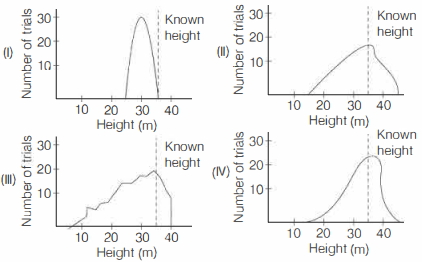
KVPY 2011, Diffcult


Download our appand get started for free
Experience the future of education. Simply download our apps or reach out to us for more information. Let's shape the future of learning together!No signup needed.*
Similar Questions
- 1The characteristic distance at which quantum gravitational effects are significant, the Planck length, can be determined from a suitable combination of the fundamental physical constants $G, h$ and $c$ . Which of the following correctly gives the Planck length?View Solution
- 2If $C$ and $R$ represent capacitance and resistance respectively, then the dimensions of $RC$ areView Solution
- 3View SolutionWhich one of the following does not have the same dimensions
- 4View SolutionWhich is dimensionless
- 5Time period $T\,\propto \,{P^a}\,{d^b}\,{E^c}$ then value of $c$ is given $p$ is pressure, $d$ is density and $E$ is energyView Solution
- 6The mass of a liquid flowing per second per unit area of cross section of a tube is proportional to $P^x$ and $v^y$ , where $P$ is the pressure difference and $v$ is the velocity. Then, the relation between $x$ and $y$ isView Solution
- 7The dimension of $P = \frac{{{B^2}{l^2}}}{m}$ isView Solution
where $B=$ magnetic field, $l=$ length, $m =$ mass
- 8The amount of heat produced in an electric circuit depends upon the current $(I),$ resistance $(R)$ and time $(t).$ If the error made in the measurements of the above quantities are $2\%, 1\%$ and $1\%$ respectively then the maximum possible error in the total heat produced will be $ ........... \%$View Solution
- 9The radius of a thin wire is $0.16\; mm$. The area of cross-section taking significant figure into consideration in square millimeters is?View Solution
- 10Error in volume of a sphere is $6\%$. Error in its radius will be .......... $\%$View Solution