Question
$\frac{2\text{x}}{3}-\frac{3\text{x}}{8}=\frac{7}{12}$

Answer

$\frac{2\text{x}}{3}-\frac{3\text{x}}{8}=\frac{7}{12}$
$\frac{16\text{x}-9\text{x}}{24}=\frac{7}{12}$ (L.C.M of 3, 8 = 24)
$\frac{7\text{x}}{24}=\frac{7}{12}$
Dividing by $\frac{7}{24}$
$=\frac{7\text{x}}{24}​+\frac{7}{24}=\frac{7}{12}+\frac{7}{24}$
$\Rightarrow\frac{7\text{x}}{24}​\times\frac{24}{7}=\frac{7}{12}\times\frac{24}{12}$
$\Rightarrow\text{x}=2$
$\therefore\text{x}=2$
Verification:
$\text{L.H.S}$ $=\frac{2\text{x}}{3}-\frac{\text{3x}}{8}=\frac{3\text{x}}{8}$
$=\frac{2\times2}{3}-\frac{3\times2}{8}=\frac{4}{3}-\frac{6}{8}$
$=\frac{4}{3}-\frac{3}{4}=\frac{16-9}{12}=\frac{7}{12}$
$=\frac{7}{12}=\text{R.H.S}$

Need a full question paper?

Generate a complete, print-ready paper with questions like this in minutes — across 16+ boards, with answer keys.
Start Generating Free

Similar questions

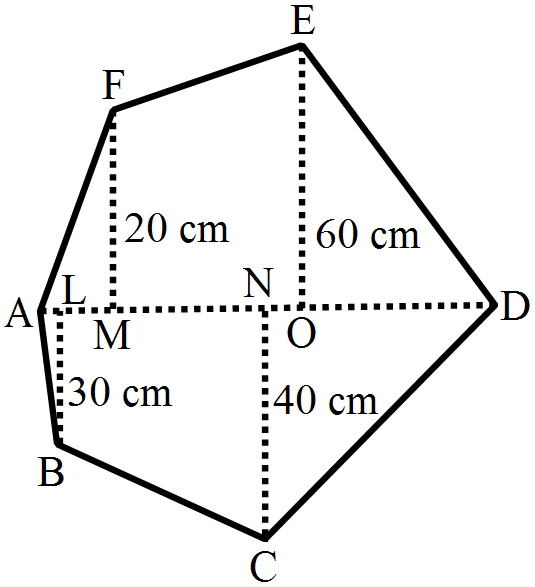
Find the area of the following polygon, if AL = 10cm, AM = 20cm, AN = 50cm, AO = 60cm and AD = 90cm.

Draw a rectangle whose one side measures 8cm and the length of each of whose diagonals is 10cm.
Solve the following equation and also check your result in case:
$\frac{(45-2\text{x)}}{15}-\frac{(4\text{x}+10)}{5}=\frac{(15-14\text{x})}{9}$
The following line graph shows the change in temperature of a block of ice when heated.
Study the above graph carefully and answer the questions given below:
  1. For how many seconds did the ice block have no change in temperature?
  2. For how long was there a change in temperature?
  3. After how many seconds of heating did the temperature become constant at 100°C?
  4. What was the temperature after 25 seconds?
  5. What will be the temperature after 1.5 minutes? Justify your answer.
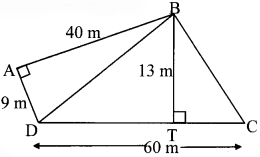
Some measures are given in the figure, find the area of ☐ABCD.
Image
Verify associativity of addition of rational numbers i.e., (x + y) + z = x + (y + z), when:
$\text{x}=\frac{1}{2},\text{y}=\frac{2}{3},\text{z}=-\frac{1}{5}$
Diagonals of parallelogram ABCD intersect at O as shown in the figure. XY contains O, and X, Y are points on opposite sides of the parallelogram. Give reasons for each of the following:
  1. $\text{OB}=\text{OD}$
  2. $\angle\text{OBY}=\angle\text{ ODX}$
  3. $\angle\text{BOY}=\angle\text{DOX}$
  4. $\triangle\text{BOY}=\triangle\text{DOX}$
Now, state if XY is bisected at O.
A grocer bought sugar worth Rs. 4500. He sold one-third of it at a gain of 10%. At what gain percent must the remaining sugar be sold to have a gain of 12% on the whole?
Verify associativity of addition of rational numbers i.e., (x + y) + z = x + (y + z), when:
$\text{x}=-2,\text{y}=\frac{3}{5},\text{z}=\frac{-4}{3}$
x varies inversely as y, when x = 15 then y = 10, if x = 20, then y = ?