Question
$\frac{\text{x}}{2}+\frac{\text{x}}{8}=\frac{1}{8}$

Answer

$\frac{\text{x}}{2}+\frac{\text{x}}{8}=\frac{1}{8}$
$\frac{4\text{x}+\text{x}}{8}=\frac{1}{8}$ (L.C.M of 2, 8 = 8)
$\frac{5\text{x}}{8}=\frac{1}{8}$
Dividing by $\frac{5}{8}$
$\frac{5}{8}\text{x}​+\frac{5}{8}=​​​​\frac{1}{8}+\frac{5}{8}$
$\Rightarrow\frac{5}{8}\text{x}​\times\frac{8}{5}=​​\frac{1}{8}\times\frac{5}{8}$
$\Rightarrow\text{x}=\frac{1}{5}$
$\therefore\text{x}=\frac{1}{5}$
Verification:
$\text{L.H.S}$ $=\frac{\text{x}}{2}+\frac{\text{x}}{8}$
$=\frac{\frac{1}{5}}{2}+\frac{\frac{1}{5}}{8}=\frac{1}{5\times2}+\frac{1}{5\times8}$
$=\frac{1}{10}+\frac{1}{40}=\frac{4+1}{40}=\frac{5}{40}$
$=\frac{1}{8}=\text{R.H.S}$

Need a full question paper?

Generate a complete, print-ready paper with questions like this in minutes — across 16+ boards, with answer keys.

Start Generating Free

Similar questions

Construct the triangles with given measures.
∆DEF: m∠D = 35°, m∠F = 100°, l(DF) = 4.8 cm.
The area of a square field is $5184 cm^2$. A rectangular field, whose length is twice its breadth has its perimeter equal to the perimeter of the square field. Find the area of the rectangular field.
A rectangular grassy plot is 112m long and 78m broad. It has a gravel path 2.5m wide all around it on the side. Find the area of the path and the cost of constructing it at Rs. 4.50 per square metre.
The following table shows how a student spends his pocket money during the course of a month. Represent it by a pie-diagram.
Items
Food
Entertainment
Other expenditure
Savings
Expenditure
40%
25%
20%
15%
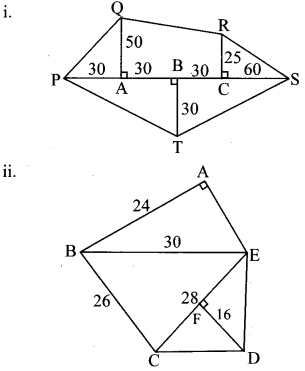
Find the areas of given plots. (All measures are in meters.)
Image
Shabana bought 16 dozen ball pens and sold then at a loss equal to S.P. of 8 ball pens. Find
(i) Her loss percent
(ii) S.P. of 1 dozen ball pen, if she purchased these 16 dozen ball pens for Rs. 576.
The length of a side of a square field is 4m. what will be the altitude of the rhombus, if the area of the rhombus is equal to the square field and one of its diagonal is 2m?
Construct a quadrilateral ABCD, where AB = 5.5cm, BC = 3.7cm, $\angle\text{A}=60^\circ,$ $\angle\text{B}=105^\circ$ and $\angle\text{D}=90^\circ$
Draw a sufficiently large ∆ABC.
Draw medians; seg AR, seg BQ and seg CP of ∆ABC.
Name the point of concurrence as G.
Measure the lengths of segments from the figure and fill in the boxes in the following table.
\begin{tabular}{|l|l|l|}
\hline$I(A G)=$ & $I(G R)=$ & $I(A G): I(G R)=$ \\
\hline$I(B G)=$ & $I(G Q)=$ & $I(B G): I(G Q)=$ \\
\hline$I(C G)=$ & $I(G P)=$ & $I(C G): I(G P)=$ \\
\hline
\end{tabular}

Observe that all of these ratios are nearly 2 : 1

The following table gives the information regarding length of a side of a square and its area:
Length of a side (in cm): 1 2 3 4 5
Area of square (in $cm^2$): 1 4 9 16 25
Draw a graph to illustrate this information.