MCQ
Frequency of a wave is $6 \times {10^{15}}Hz.$ The wave is
  • A
    Radiowave
  • B
    Microwave
  • C
    $X-$ ray
  • None of these

Answer

Correct option: D.
None of these
d
$f=6 \times 10^{15}\,Hz$

$\lambda=\frac{c}{f}=\frac{3 \times 10^8}{6 \times 10^{15}}\,m$

$m \lambda=5 \times 10^{-8}\,m$

for, $10^{-8} m < \lambda < 10^{-11} m$ it is $x$-ray

Need a full question paper?

Generate a complete, print-ready paper with questions like this in minutes — across 16+ boards, with answer keys.
Start Generating Free

Similar questions

A milliammeter of range $10\, mA$ has a coil of resistance $1 \,\Omega$. To use it as voltmeter of range $10\, volt$, the resistance that must be connected in series with it, will be ............. $\Omega $
When a slow neutron goes sufficiently close to a $\mathrm{U}^{235}$ nucleus, then the process that takes place is
The probability of electrons to be found in the conduction band of an intrinsic semiconductor at a finite temperature
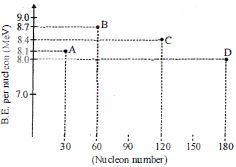
The positions of four different nuclei in the binding energy curve are shown in figure. The process that might not proceed spontaneously is
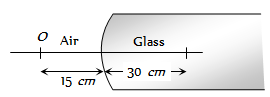
A point object O is placed in front of a glass rod having spherical end of radius of curvature 30 cm. The image would be formed at
Two conductors made of the same material are connected across a common potential difference. Conductor A has twice the diameter and twice the length of conductor B. The power delivered to the two conductors $P_A$ and $P_B$ respectively is such that $P_A/P_B$ equals to
A double charged lithium atom is equivalent to hydrogen whose atomic number is 3. The wavelength of required radiation for emitting electron from first to third Bohr orbit in $Li^{++}$ will be (Ionisation energy of hydrogen atom is 13.6eV) 
The focal length of lens of refractive index 1.5 in air is 30 cm. When it is immersed in a liquid of refractive index $\frac {4}{3}$, then its focal length in liquid will be
A cell of internal resistance $r$ is connected across an external resistance $n r$. Then the ratio of the terminal voltage to the emf of the cell is
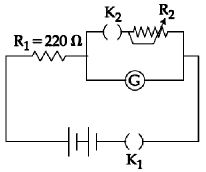
The galvanometer deflection, when key $K_1$ is closed but $K_2$ is open, equals $\theta_0$ (see figure). On closing $K_2$ also and adjusting $R_2$ to $5\,\Omega $ , the deflection in galvanometer becomes $\frac{{\theta _0}}{5}$. The resistance of the galvanometer is, then, given by [Neglect the internal resistance of battery]: .................. $\Omega$