MCQ
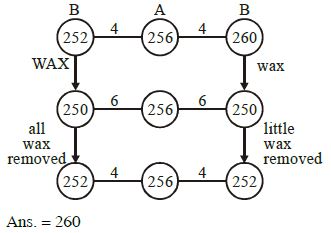
Frequency of tuning fork $A$ is $256\,Hz$ . It produces four $beats/sec$ . with tuning fork $B$ . When wax is applied at tuning fork $B$ then $6\,beats/sec$ . are heard. By reducing little amount of wax $4\,beats/sec$ . are heard. Frequency of $B$ is .... $Hz$
  • A
    $250$
  • $260$
  • C
    $252$
  • D
    $256$

Answer

Correct option: B.
$260$
b

Need a full question paper?

Generate a complete, print-ready paper with questions like this in minutes — across 16+ boards, with answer keys.

Start Generating Free

Similar questions

In an orbital motion, the angular momentum vector is
If the sun and the planets carried huge amounts of opposite charges,
  1. All three of Kepler’s laws would still be valid.
  2. Only the third law will be valid.
  3. The second law will not change.
  4. The first law will still be valid.
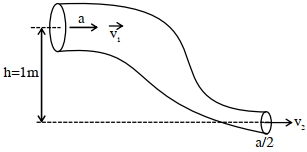
An ideal fluid of density $800 \; kgm ^{-3}$, flows smoothly through a bent pipe (as shown in figure) that tapers in cross-sectional area from $a$ to $\frac{ a }{2}$. The pressure difference between the wide and narrow sections of pipe is $4100 \; Pa$. At wider section, the velocity of fluid is $\frac{\sqrt{x}}{6} \; ms ^{-1}$ for $x = \dots$ $\left(\right.$ Given $g =10 \; m ^{-2}$ )
A body of mass $2\ kg$ travels according to the law $x(t) = pt + qt^2 rt^3$ where $p = 3\ m s^{-1}, q = 4\ m s^{-2}$ and $r = 5\ m s^{-3}.$ The force acting on the body at $t = 2$ seconds is.
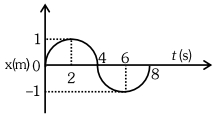
The $x-t$ graph of a particle performing simple harmonic motion is shown in the figure. The acceleration of the particle at $t=2 s$ is :
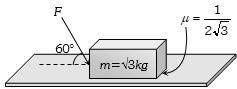
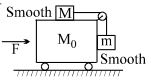
What is the maximum value of the force $F$ such that the block shown in the arrangement, does not move ........ $N$
An object moving in a circular path at constant speed has constant
A tuning fork of known frequency $256\,Hz$ makes $5$ beats per second with the vibrating string of a piano. The beat frequency decreases to $2$ beats per second when the tension in the piano string is slightly increased. The frequency of the piano string before increasing the tension was
At atmospheric pressure, the water boils at $100°C$. If pressure is reduced, it will boil at
Imagine $a$ situation in which the horizontal surface of block $M_0$ is smooth and its vertical surface is rough with $a$ coefficient of friction $\mu$ Consider a special situation in which both the faces of the block $M_0$ are smooth, as shown in adjoining figure. Mark out the correct statement $(s)$