MCQ
Frequency range of the audible sounds is
  • A
    $0 Hz -30 Hz$
  • $20 Hz -20 kHz$
  • C
    $20 kHz -20,000 kHz$
  • D
    $20 kHz -20 MHz$

Answer

Correct option: B.
$20 Hz -20 kHz$
b
(b) The human ear responds to sounds with frequencies in the range from $20 \mathrm{Hz}$ to $20000 \mathrm{Hz}$. This is called the audible range of the human ear.

Thus, the frequency range of audible sound is $20 \mathrm{H} z$ to $20000 \mathrm{Hz}$.

Need a full question paper?

Generate a complete, print-ready paper with questions like this in minutes — across 16+ boards, with answer keys.
Start Generating Free

Similar questions

Consider two rods of same length and different specific heats $\left(S_{1}, S_{2}\right)$, conductivities $\left(K_{1}, K_{2}\right)$ and area of cross-sections $\left(A_{1}, A_{2}\right)$ and both having temperatures $T_{1}$ and $T_{2}$ at their ends. If rate of loss of heat due to conduction is equal, then
A wave disturbance in a medium is described by $y(x,\,t) = 0.02\cos \,\left( {50\,\pi t + \frac{\pi }{2}} \right)\cos (10\pi x)$, where $ x$ and $y$ are in metres and $t$ in seconds
The displacement of a particle is represented by the equation $y = sin^3\,\,\,\omega t$ . The motion is
An ideal black body at room temperature is thrown into a furnace. It is observed that
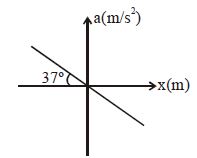
The acceleration displacement graph of a particle executing $SHM$  is shown in figure. The time period of simple harmonic motion is
An inductance coil has a reactance of $100\, \Omega$. When an $AC$ signal of frequency $1000\, Hz$ is applied to the coil, the applied voltage leads the current by $45^{\circ}$. The self- inductance of the coil is
A point source of electromagnetic radiation has an average power output of $800\, W.$ The maximum value of electric field at a distance $4.0 \,m$ from the source is....$V/m$
If ${\lambda _1}$ and ${\lambda _2}$ are the wavelengths of characteristic $X-$ rays and gamma rays respectively, then the relation between them is
A lens having focal length $f$ and aperture of diameter $d$ forms an image of intensity $I$. Aperture of diameter $\frac{ d }{2}$ in central region of lens is covered by a black paper. Focal length of lens and intensity of image now will be respectively
An electron having mass $m$ and kinetic energy $K$ enter in uniform magnetic field $B$ perpendicularly, then its frequency will be