MCQ
Frequency range of the audible sounds is
  • A
    $0 Hz -30 Hz$
  • $20 Hz -20 kHz$
  • C
    $20 kHz -20,000 kHz$
  • D
    $20 kHz -20 MHz$

Answer

Correct option: B.
$20 Hz -20 kHz$
b
(b) The human ear responds to sounds with frequencies in the range from $20 \mathrm{Hz}$ to $20000 \mathrm{Hz}$. This is called the audible range of the human ear.

Thus, the frequency range of audible sound is $20 \mathrm{H} z$ to $20000 \mathrm{Hz}$.

Need a full question paper?

Generate a complete, print-ready paper with questions like this in minutes — across 16+ boards, with answer keys.

Start Generating Free

Similar questions

A person is standing at -2 location on the number line. He runs to and fro from -2 to +5 location 5 times. How much distance has he covered if he comes back to -2 location at the end?
An electric current i enters and leaves a uniform circular wire of radius a through diametrically opposite points. A charged particle q moving along the axis of the circular wire passes through its centre at speed v. The magnetic force acting on the particle when it passes through the centre has a magnitude:

  1. $\text{qv}\frac{\mu_0\text{i}}{2\text{a}}$

  2. $\text{qv}\frac{\mu_0\text{i}}{2\pi\text{a}}$

  3. $\text{qv}\frac{\mu_0\text{i}}{\text{a}}$

  4. $\text{Zero}$

A travelling wave pulse is given by $y=\frac{4}{3 x^2+48 t^2+24 x t+2}$ where $x$ and $y$ are in metre and $t$ is in second. The velocity of wave is ........... $m / s$
The relationship between pressure and the density of a gas expressed by Boyle’s law, $ P = KD$ holds true
The tension of a stretched string is increased by $69\%$. In order to keep its frequency of vibration constant, its length must be increased by .... $\%$
The r.m.s. speed of gas molecules is given by
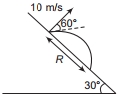
A projectile is launched with a speed of $10\,m / s$ at an angle $60^{\circ}$ with the horizontal from a sloping surface of inclination $30^{\circ}$. The range $R$ is $........\,m$ (Take $g=10\,m / s ^2$ )
What is the ratio of specific heats of constant pressure and constant volume for $N{H_3}$
Match List $I$ with List $II$

List $I$ List $II$
$(A)$ Young's Modulus $(Y)$ $(I)$ $\left[ M L ^{-1} T ^{-1}\right]$
$(B)$ Co-efficient of Viscosity $(\eta)$ $(II)$ $\left[ M L ^2 T ^{-1}\right]$
$(C)$ Planck's Constant $(h)$ $(III)$ $\left[ M L ^{-1} T ^{-2}\right]$
$(D)$ Work Function $(\phi)$ $(IV)$ $\left[ M L ^2 T ^{-2}\right]$

Choose the correct answer from the options given below:

If the water falls from a dam into a turbine wheel $19.6\, m$ below, then the velocity of water at the turbines, is ..................  $\mathrm{m} / \mathrm{s}$ (take $g = 9.8\, m/s^2$)