MCQ
From a circular disc of radius $R$ and mass $9M$, a small disc of mass $M$ and radius $\frac{R}{3}$ is removed concentrically. The moment of inertia of the remaining disc about an axis perpendicular to the plane of the disc and passing through its centre is
  • A
    $M{R^2}$
  • B
    $4M{R^2}$
  • C
    $\frac{4}{9}\,M{R^2}$
  • $\frac{40}{9}\,M{R^2}$

Answer

Correct option: D.
$\frac{40}{9}\,M{R^2}$
d
$\mathrm{I}_{\mathrm{net}}=\mathrm{I}_{\mathrm{disc}}-\mathrm{I}_{\mathrm{removed}}$

$=\frac{1}{2}(9 M) R^{2}-\frac{1}{2} M\left(\frac{R}{3}\right)^{2}=\frac{40}{9} \,M R^{2}$

Need a full question paper?

Generate a complete, print-ready paper with questions like this in minutes — across 16+ boards, with answer keys.

Start Generating Free

Similar questions

Moment of inertia of a square plate of side $l$ about the axis passing through one of the corner and perpendicular to the plane of square plate is given by
An earthen pitcher used in summer cools water in it essentially by evaporation of water from its porous surface. If a pitcher carries $4 \,kg$ of water and the rate of evaporation is $20$ g per hour, temperature of water in it decreases by $\Delta T$ in two hours. The value of $\Delta T$ is close to ........... $^{\circ} C$ (ratio of latent of evaporation to specific heat of water is $540^{\circ} C$
Time period of a particle executing $SHM$ is $8\, sec.$ At $t = 0$ it is at the mean position. The ratio of the distance covered by the particle in the $1^{st}$ second to the $2^{nd}$ second is :
If $\gamma $ denotes the ratio of two specific heats of a gas, the ratio of slopes of adiabatic and isothermal $PV$ curves at their point of intersection is
A vessel contains $110\, g$ of water. The heat capacity of the vessel is equal to $10\, g$ of water. The initial temperature of water in vessel is $10°C.$ If $220\, g$ of hot water at $70°C$ is poured in the vessel, the final temperature neglecting radiation loss, will be........ $^oC$
The initial velocity of a body moving along a straight line is $7 \,m/s$. It has a uniform acceleration of $4\,m/{s^2}$. The distance covered by the body in the $5^{th}$ second of its motion is..........$m$
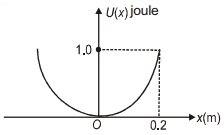
A particle of mass $4 \,kg$ moves simple harmonically such that its $P E(U)$ varies with position $x$, as shown. The period of oscillations is ............
$STATEMENT-1$ It is easier to pull a heavy object than to push it on a level ground. and

$STATEMENT-2$ The magnitude of frictional force depends on the nature of the two surfaces in contact.

The law of areas can be interpreted as:
Two straight metallic strips each of thickness $t$ and length $\ell$ are rivetted together. Their coefficients of linear expansions are $\alpha_1$ and $\alpha_2$. If they are heated through temperature $\Delta T$, the bimetallic strip will bend to form an arc of radius