From Kirchoff’s law the ratio of emissive power and absorption power of all bodies
Easy
Download our app for free and get started
Kirchoff's Law

Download our appand get started for free
Experience the future of education. Simply download our apps or reach out to us for more information. Let's shape the future of learning together!No signup needed.*
Similar Questions
- 1A black body at a temperature of $1640\,\,K$ has the wavelength corresponding to maximum emission equal to $1.75 \,\,\mu m.$ Assuming the moon to be a perfectly black body, the temperature of the moon, if the wavelength corresponding to maximum emission is $14.35\,\,\mu m$ is.......$K$View Solution
- 2A cubic metal block of mass $5 \,kg$ and edge length $0.1 \,m$ and at an initial temperature of $100^{\circ} C$ is placed on a thermally insulating flat surface and exposed to air at $0^{\circ} C$. The time in seconds required to cool the block to a temperature of $37^{\circ} C$ is closest toView Solution
(Note: Specific heat of the metal $=500 \,J / kg /{ }^{\circ} C$; Heat transfer coefficient from block to air $=50 \,W / m ^2 /{ }^{\circ} C$ )
- 3A copper pipe of length $10 \,m$ carries steam at temperature $110^{\circ} C$. The outer surface of the pipe is maintained at a temperature $10^{\circ} C$. The inner and outer radii of the pipe are $2 \,cm$ and $4 \,cm$, respectively. The thermal conductivity of copper is $0.38 kW / m /{ }^{\circ} C$. In the steady state, the rate at which heat flows radially outward through the pipe is closest to ............. $\,kW$View Solution
- 4A slab consists of two parallel layers of copper and brass of the same thickness and having thermal conductivities in the ratio $1 : 4$ . If the free face of brass is at ${100^o}C$ and that of copper at $0^\circ C $, the temperature of interface is ........ $^oC$View Solution
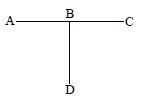
- 5Three conducting rods of same material and cross section are shown in figure. Temperature at $A,D$ and $C$ are maintained at $20\ ^oC, 90\ ^oC$ and $0\ ^oC$. The ratio of lengths of $BD$ and $BC$ if there is no heat. Flows in $AB$ isView Solution
- 6View SolutionA block of metal is heated to a temperature much higher than the room temperature and allowed to cool in a room free from air currents. Which of the following curves correctly represents the rate of cooling
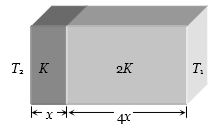
- 7The temperature of the two outer surfaces of a composite slab, consisting of two materials having coefficients of thermal conductivity $K$ and $2K$ and thickness $x$ and $4x$ , respectively are $T_2$ and $T_1$ ($T_2$ > $T_1$). The rate of heat transfer through the slab, in a steady state is $\left( {\frac{{A({T_2} - {T_1})K}}{x}} \right)f$, with $f $ which equal toView Solution
- 8The 'Kangri' is an earthen pot used to stay warm in Kashmir during the winter months. Assume that the 'Kangri' is spherical and of surface area $7 \times 10^{-2} \,m ^{2}$. It contains $300 g$ of a mixture of coal, wood and leaves with calorific value of $30 \,kJ / g$ (and provides heat with $10 \%$ efficiency). The surface temperature of the 'Kangri' is $60^{\circ} C$ and the room temperature is $0^{\circ} C$. Then, a reasonable estimate for the duration $t$ (in h) that the 'Kangri' heat will last is (take the 'Kangri' to be a black body)View Solution
- 9A body takes $5$ minutes for cooling from ${50^o}C$ to ${40^o}C.$ Its temperature comes down to ${33.33^o}C$ in next $5$ minutes. Temperature of surroundings is ....... $^oC$View Solution
- 10View SolutionThe spectrum from a black body radiation is a