Question
From Newton's second law of motion, it can be inferred that

Answer

(d)

By Newton's second law

$\vec{F}=m \vec{a}$

for $(1)$ Uniform motion means body is moving with constant velocity. By $(i)$ it can be said that only for accelerated motion force is required

$(2)$ is true using $(i)$

$(3)$ Using $(i)$ $\vec{a}=\frac{\vec{F}}{m}$ so this is true

Need a full question paper?

Generate a complete, print-ready paper with questions like this in minutes — across 16+ boards, with answer keys.
Start Generating Free

Similar questions

A motor drives a body along a straight line with a constant force. The power $P$ developed by the motor must vary with time $t$ according to
Tuning fork ${F_1}$ has a frequency of $256 Hz$ and it is observed to produce $6$ beats/second with another tuning fork ${F_2}$. When ${F_2}$ is loaded with wax, it still produces $6$ beats/second with ${F_1}$. The frequency of ${F_2}$ before loading was ..... $Hz$
A body of mass $5\, kg$ is placed at the origin, and can move only on the $ x-$axis. A force of $10\, N$ is acting on it in a direction making an angle of ${60^o}$ with the $x-$axis and displaces it along the $x-$axis by $4 \,metres$. The work done by the force is......$J$
Which one of the following graph for a body moving along a straight line is possible?
Four point charges $-Q, -q, 2q$ and $2Q$ are placed, one at each comer of the square. The relation between $Q$ and $q$ for which the potential at the centre of the square is zero is
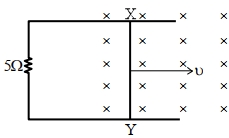
A $1\,m$ long metal rod $XY$ completes the circuit as shown in figure. The plane of the circuit is perpendicular to the magnetic field of flux density $0.15\,T$. If the resistance of the circuit is $5\,\Omega$, the force needed to move the rod in direction, as indicated, with a constant speed of $4\,m / s$ will be $................\,10^{-3}\,N$
Two metal spheres, one of radus $R$ and the other of radius $2 R$ respectively have the same surface charge density $\sigma$. They are brought in contact and separated. What will be the new surface charge densities on them?
A body of mass $m$ is allowed to fall with the help of string with downward acceleration $\frac{g}{6}$ to a distance $x$. The work done by the string is .............
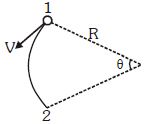
A ring of mass $m$ moves from point $1$ to point $2$ along a smooth rigid horizontal wire with a constant speed $v$. The average force acting the ring over the time of its motion from $1$ to $2$ is
A hydrogen atom in is ground state absorbs $10.2\;eV$ of energy. The angular momentum of electron of the hydrogen atom will increase by the value of ............... $\times 10^{-34} \; J {s}$ (Given, Plank's constant $\left.=6.6 \times 10^{-34} Js \right)$