MCQ
From Newton's second law of motion, it can be inferred that
  • A
    No force is required to move a body uniformly along straight line 
  • B
    Accelerated motion is always due to an external force
  • C
    Inertial mass of a body is equal to force required per unit acceleration in the body
  • All of these

Answer

Correct option: D.
All of these
d
(d)

By Newton's second law

$\vec{F}=m \vec{a}$

for $(1)$ Uniform motion means body is moving with constant velocity. By $(i)$ it can be said that only for accelerated motion force is required

$(2)$ is true using $(i)$

$(3)$ Using $(i)$ $\vec{a}=\frac{\vec{F}}{m}$ so this is true

Need a full question paper?

Generate a complete, print-ready paper with questions like this in minutes — across 16+ boards, with answer keys.

Start Generating Free

Similar questions

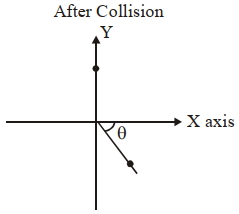
A ball of mass $10\, kg$ moving with a velocity $10 \sqrt{3}\, ms ^{-1}$ along $X-$axis, hits another ball of mass $20\, kg$ which is at rest. After collision, the first ball comes to rest and the second one disintegrates into two equal pieces. One of the pieces starts moving along $Y-$ axis at a speed of $10\, m / s$. The second piece starts moving at a speed of $20\, m / s$ at an angle $\theta$ (degree) with respect to the $X-$axis. The configuration of pieces after collision is shown in the figure. The value of $\theta$ to the nearest integer is
In the Arctic region, hemispherical houses called Igloos are made of ice. It is possible to maintain a temperature inside an Igloo as high as $20^{\circ} C$ because
If velocity$(V)$, force$(F)$ and time$(T)$ are chosen as fundamental quantities then dimensions of energy are 
Bulk modulus was first defined by
In a rocket, fuel burns at the rate of $2 \,kg / s$. This fuel gets efected from the rocket with a velocity of $80 \,km / s$. Force exerted on the rocket is ............. $N$
A student performs an experiment to determine the acceleration due to gravity $g$. The student throws a steel ball up with initial velocity $u$ and measures the height $h$ travelled by it at different times $t$. The graph the student should plot on a graph paper to readily obtain the value of $g$ is
A Carnot engine has efficiency of $50 \%$. If the temperature of sink is reduced by $40^{\circ} C$, its efficiency increases by $30 \%$. The temperature of the source will be$....K$
A heat engine operates with the cold reservoir at temperature $324 K$. The minimum temperature of the hot reservoir, if the heat engine takes $300 \; J$ heat from the hot reservoir and delivers $180 \; J$ heat to the cold reservoir per cycle, is $\dots \; K .$
A massive black hole of mass $m$ and radius $R$ is spinning with angular velocity $\omega$. The power $P$ radiated by it as gravitational waves is given by $P=G c^{-5} m^{x} R^{y} \omega^{z}$, where $c$ and $G$ are speed of light in free space and the universal gravitational constant, respectively. Then,
The amplitude of a particle executing $SHM$ is made three-fourth keeping its time period constant. Its total energy will be