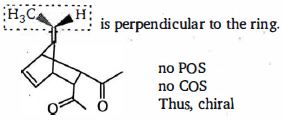
MCQ
From the above compound $(A), (B), (C)$ & $(D)$ chiral compound is
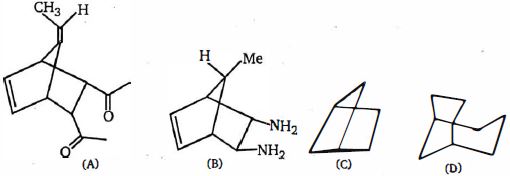
  • $A$
  • B
    $B$
  • C
    $C$
  • D
    $D$

Answer

Correct option: A.
$A$
a
Plane of symmetry and centre of symmetry is not present in compound $(A)$  $\therefore$ it is chiral

Need a full question paper?

Generate a complete, print-ready paper with questions like this in minutes — across 16+ boards, with answer keys.

Start Generating Free

Similar questions

For the equilibrium

$2{H_2}O \rightleftharpoons {H_3}{O^ + } + O{H^ - }$ , 

the value of $\Delta {G^o}$ at $298\,K$ is approximately .......$kJ\,mol^{-1}$

Which among the following orders of second $IP$ is correct
The suffix of the principal group, the prefixes for the other groups and the name of the parent in the structure

$\begin{array}{*{20}{c}}
  {HO - C{H_2} - CH - CH = C - C{H_2} - C - C - OH} \\ 
  {\,\,\,\,\,\,\,\,\,\,\,\,\,\,\,\,|\,\,\,\,\,\,\,\,\,\,\,\,\,\,\,\,\,\,\,\,\,\,\,\,\,\,\,\,\,\,|\,\,\,\,\,\,\,\,\,\,\,\,\,\,\,\,\,\,\,\,\,\,\,\,\,\,\,\,\,||\,\,\,\,\,\,\,||} \\ 
  {\,\,\,\,\,\,\,\,\,\,\,\,\,\,\,C{H_3}\,\,\,\,\,\,\,\,\,\,\,\,\,\,\,\,\,\,\,\,\,Cl\,\,\,\,\,\,\,\,\,\,\,\,\,\,\,\,\,\,\,\,\,\,\,\,\,\,\,O\,\,\,\,\,\,O\,} 
\end{array}$
Propene and propyne can be differentiated by :
The fragrance of flowers is due to the presence of some steam volatile organic compounds called essential oils. These are generally insoluble in water at room temperature but are miscible with water vapour in vapour phase. A suitable method for the extraction of these oils from the flowers is:
In which change bond order and number of unpaired $e^-$ both are increased
The following compound can exhibits
Second electron gain enthalpy
The $IUPAC$ name of compound

$\begin{array}{*{20}{c}}
  {O\,\,\,\,\,\,\,\,\,\,\,\,\,\,\,\,\,\,\,\,\,\,\,\,\,\,C{H_3}} \\ 
  {||\,\,\,\,\,\,\,\,\,\,\,\,\,\,\,\,\,\,\,\,\,\,\,\,\,\,\,\,\,\,\,\,|\,\,\,\,} \\ 
  {C{H_3} - C - CH - CH - CH - C{H_3}} \\ 
  {|\,\,\,\,\,\,\,\,\,\,\,\,\,|\,\,\,\,\,\,\,\,\,} \\ 
  {C{H_3}\,\,\,\,\,CHO\,\,} 
\end{array}$

is :

Consider one $He^+$ ion is in excited state $(n = 5)$ . Which of the following observations hold true as per the Bohr's model