Question
From the Balance Sheet given below, calculate:
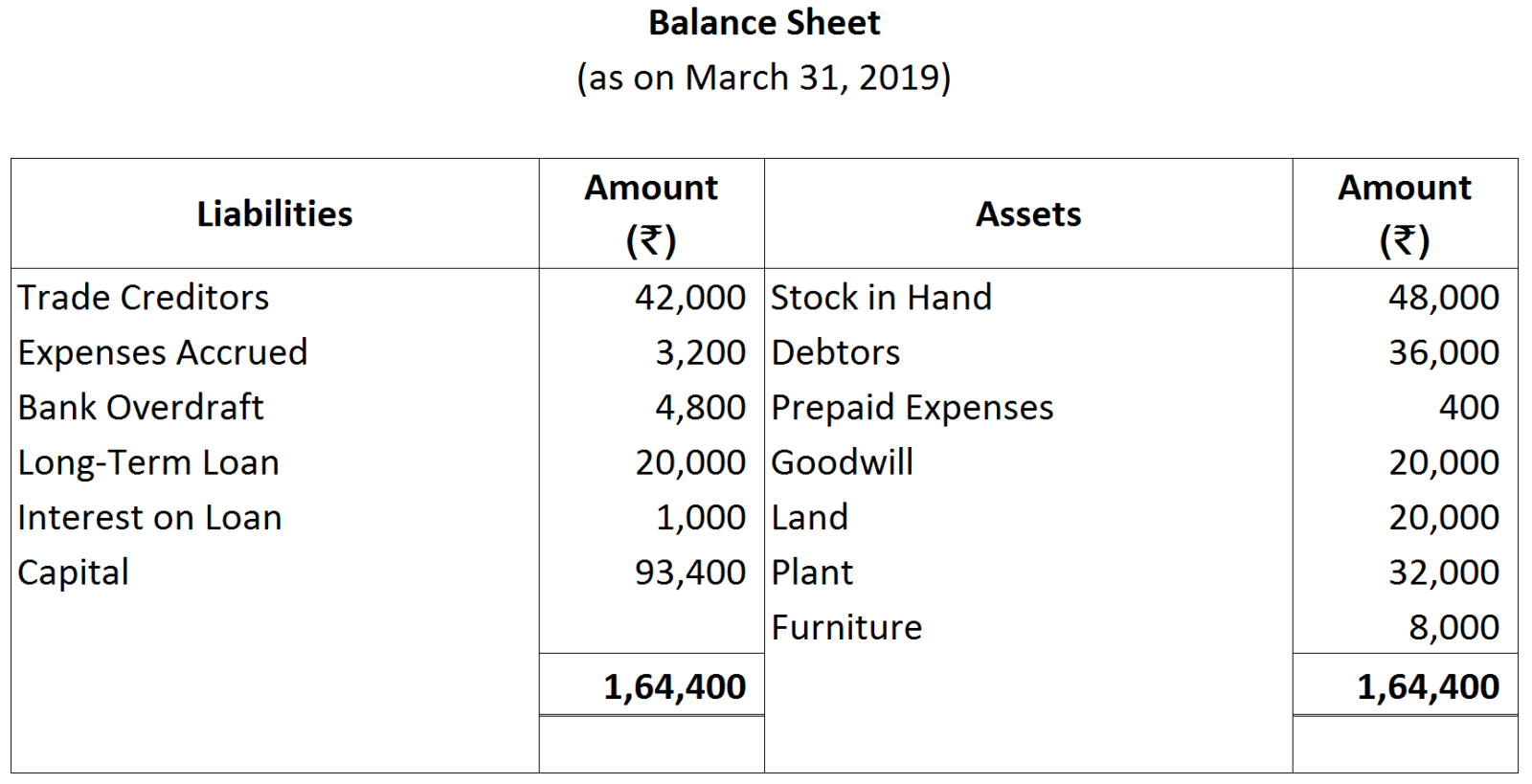
  1. Fixed Assets.
  2. Current Assets.
  3. Current Liabilities.
  4. Working Capital.
BALANCE SHEET as at $31^{st}$ March, $2019$:

Answer

  1. Fixed Assets = Land + Plant + Furniture + Goodwill
= ₹ 20,000 + ₹ 32,000 + ₹ 8,000 + ₹ 20,000 = ₹ 80,000
  1. Current Assets = Stock + Debtors + Prepaid Expenses
= ₹ 48,000 + ₹ 36,000 + ₹ 400 = ₹ 84,000
  1. Current Liabilities = Creditors + Expenses Accrued + Bank Overdraft + Interest on Loan
= ₹ 42,000 + ₹ 3,200 + ₹ 4,800 + ₹ 1,000 = ₹ 51,000
  1. Working Capital = Current Assets - Current Liabilities
= ₹ 84,400 - ₹ 51,000 = ₹ 33,400.

Need a full question paper?

Generate a complete, print-ready paper with questions like this in minutes — across 16+ boards, with answer keys.

Start Generating Free

Similar questions

What is meant by Prepaid Expenses? How are they adjusted in the Final Accounts?
What does the Balance of Suspense Account indicate? How is the balance of Suspense Account treated?
Why is it necessary to pass the Adjustment Entries?
Why balance in GST Accounts is shown in the Balance Sheet?
Write notes on the following:
  1. Accrued Income.
  2. Unearned Income.
  3. Provision for Doubtful Debts.
In a burglary at the godown of Sunshine Traders on the night of 14th July, 2023,part of the stock was stolen.
From the following particulars, find out the estimated value of loss of stock by theft
 
Stock on 1st April, 202360,000
Purchases from 1st April to 14th July, 20234,10,000
Sales from 1st April to 14th July, 20236,00,000
Stock remaining after a burglary12,000

The normal rate of gross profit for his business is $30 \%$ of the selling price.
Goods costing ₹ 26,000 were sent to a customer at 20% profit on sale on sale or return basis. Customer returned goods of the selling price of ₹ 7,000. At what amount the remaining goods with the costomer will be shown in the Balance Sheet?
From the following information, prepare Trading account for the year ended $31^{st}$​​​​​​​ March,$ 2019:$
Adjusted Purchases ₹ $5,50,000$; Sales ₹ $6,25,000$; Freight and Carriage Inwards ₹ $3,000$; Wages ₹ $7,000$; Freight and Cartage Outwards ₹ $2,500$; Closing Stock ₹ $50,000.$
Calculate the amount of bills receivable during the year.
 
Opening balance of bills receivable. 75,000
Bill dishonoured. 25,000
Bills collected (honoured) 1,30,000
Bills receivable endorsed to creditors. 15,000
Closing balance of bills receivable. 65,000
Illustrate with example the principle for valuation of stock or inventory.