MCQ
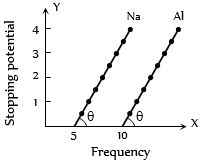
From the figure describing photoelectric effect we may infer correctly that
  • A
    $Na$ and $Al$ both have the same threshold frequency
  • Maximum kinetic energy for both the metals depend linearly on the frequency
  • C
    The stopping potentials are different for $Na$ and $Al$ for the same change in frequency
  • D
    $Al$ is a better photo sensitive material than $Na$
Answer

Correct option: B.
Maximum kinetic energy for both the metals depend linearly on the frequency
b
(b) Stopping potential equals to maximum kinetic energy.

Since stopping potential is varying linearly with the frequency.

There fore max. $KE$ for both the metals also vary linearly with frequency.


Need a full question paper?

Generate a complete, print-ready paper with questions like this in minutes — across 16+ boards, with answer keys.

Start Generating Free

Similar questions

In an $LCR $ circuit as shown below both switches are open initially. Now switch $S_1$ is closed, $S_2$ kept open. ( $q$ is charge on the capacitor and $\tau = RC$ is Capacitive time constant). Which of the following statement is correct?
A wire moves with a velocity v through a magnetic field and experiences an induced charge separation as shown in the figure. Then the direction of the magnetic field is
Image
A light ray is incident by grazing one of the face of a prism and after refraction ray does not emerge out, what should be the angle of prism while critical angle is C
Which of the following statements indicates that light waves are transverse
Isotopes of an element contain:
A ray of light is incident at an angle i from denser to rare medium. The reflected and the refracted rays are mutually perpendicular. The angle of reflection and the angle of refraction are respectively r and r’, then the critical angle will be
The ratio of gravitational force and electrostatic repulsive force between two electrons is approximately (gravitational constant $=6.7 \times 10^{-11} \,Nm ^2 / kg ^2$, mass of an electron $=9.1 \times 10^{-31} \,kg$, charge on an electron $=1.6 \times 10^{-19} C$ )
Equation of light wave, normally incident on a surface is $B = \left( {100nT} \right)\sin (2\pi ({10^{15}}t - \left( {3 \times {{10}^{ - 7}}} \right)x) + \frac{\pi }{6})$ .Find intensity of light on that surface ...$W/m^2$
Value of refractive index for any medium is:
An electron microscope is operated at $40\ kV$. The ratio of resolving power of this microscope and another one which uses yellow light of wavelength $6 × 10^{-7}\ m$, is