Question
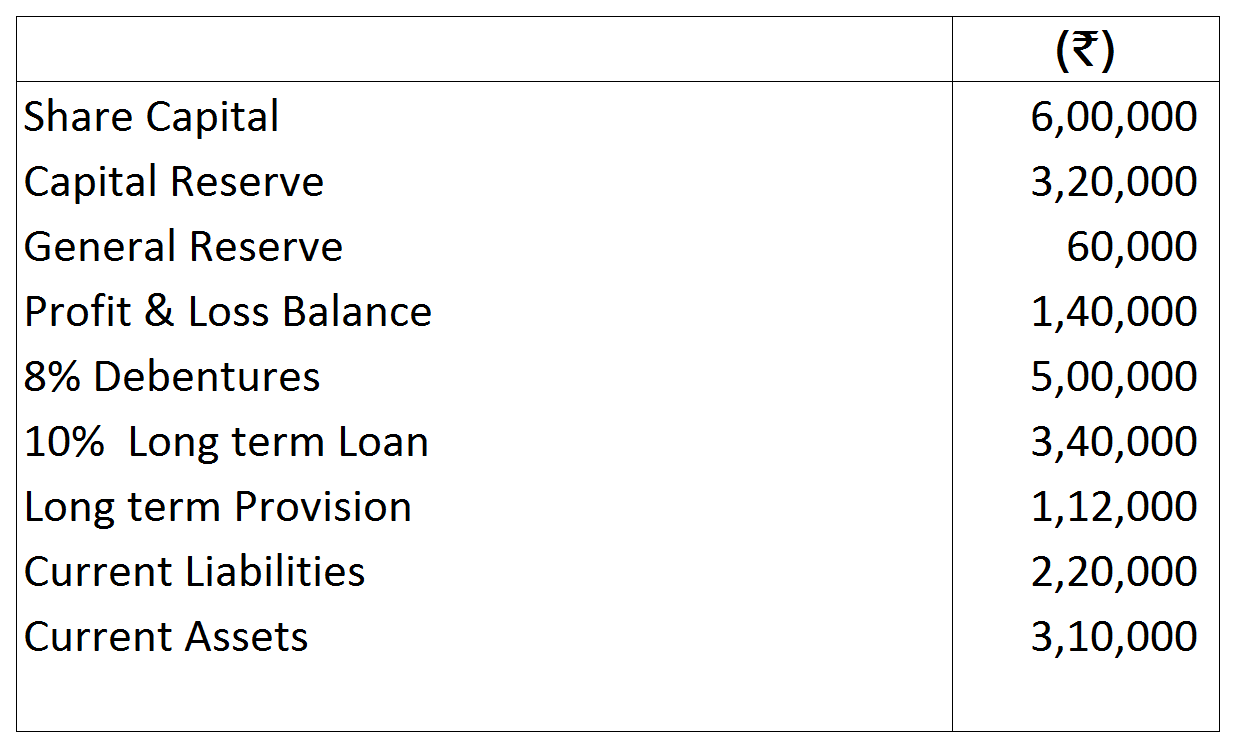
From the following ascertain Debt - Equity Ratio:
Answer

Debt - Equity Ratio $=\frac{\text{Debt}}{\text{Equity}}\text{ or }\frac{\text{Long term Debts}}{\text{Shareholder's Funds}}$
Long term Debts = 8% Debentures + 10% Long term Loan + Long term Provision.
= ₹ 5,00,000 + ₹ 3,40,000 = ₹ 1,12,000
= ₹ 9,52,000
Shareholder's Funds = Share Capital + Capital Reserve + General Reserve + Profit & Loss Balance.
= ₹ 6,00,000 + ₹ 3,20,000 + ₹ 60,000 + ₹ 1,40,000
= ₹ 11,20,000
Debt Equity Ratio $=\frac{₹\ 9,52,000}{₹\ 11,20,000}=0.85:1.$

Need a full question paper?

Generate a complete, print-ready paper with questions like this in minutes — across 16+ boards, with answer keys.
Start Generating Free

Similar questions

Calculate Working Capital Turnover Ratio from the following:
Net Profit after Interest and Tax ₹ 30,000; Fixed Assets ₹ 3,80,000; Current Assets ₹ 1,70,000; Current Liabilities ₹ 50,000; 10% Long-Term Debt ₹ 2,00,000. Tax Paid ₹ 30,000. Calculate Return on Investment
A company had Current Assets of ₹ 4,50,000 and Current Liabilities of ₹ 2,00,000. Afterwards it purchased goods for ₹ 30,000 on credit. Calculate Current Ratio after the purchase.
Under which sub-headings will the following items be placed in the Balance Sheet of a company as per revised Schedule VI Part I of the Companies Act, 1956:
  1. Capital Reserves.
  2. Bonds.
  3. Loans repayable on demand.
  4. Vehicles.
  5. Goodwill.
  6. Loose tools.
Illustrate the method of determining trade receivables turnover ratio What does it indicate?
Liquid Ratio 7 : 3; Current Liabilities ₹ 75,000; Inventory ₹ 25,000 Calculate Current Ratio.
Mr. Arun Birla owns a business and gives the following figures for two successive years:
 
1st Year
2nd Year
 
Revenue from Operations
60,000
1,20,00
Gross Profit
15,000
24,000
Mr. Arun Birla speaks very high of his Manager who has increased the profits from ₹ 15,000 to ₹ 24,000 and describes him very 'Efficient'. Do you agree with him? If not, why?
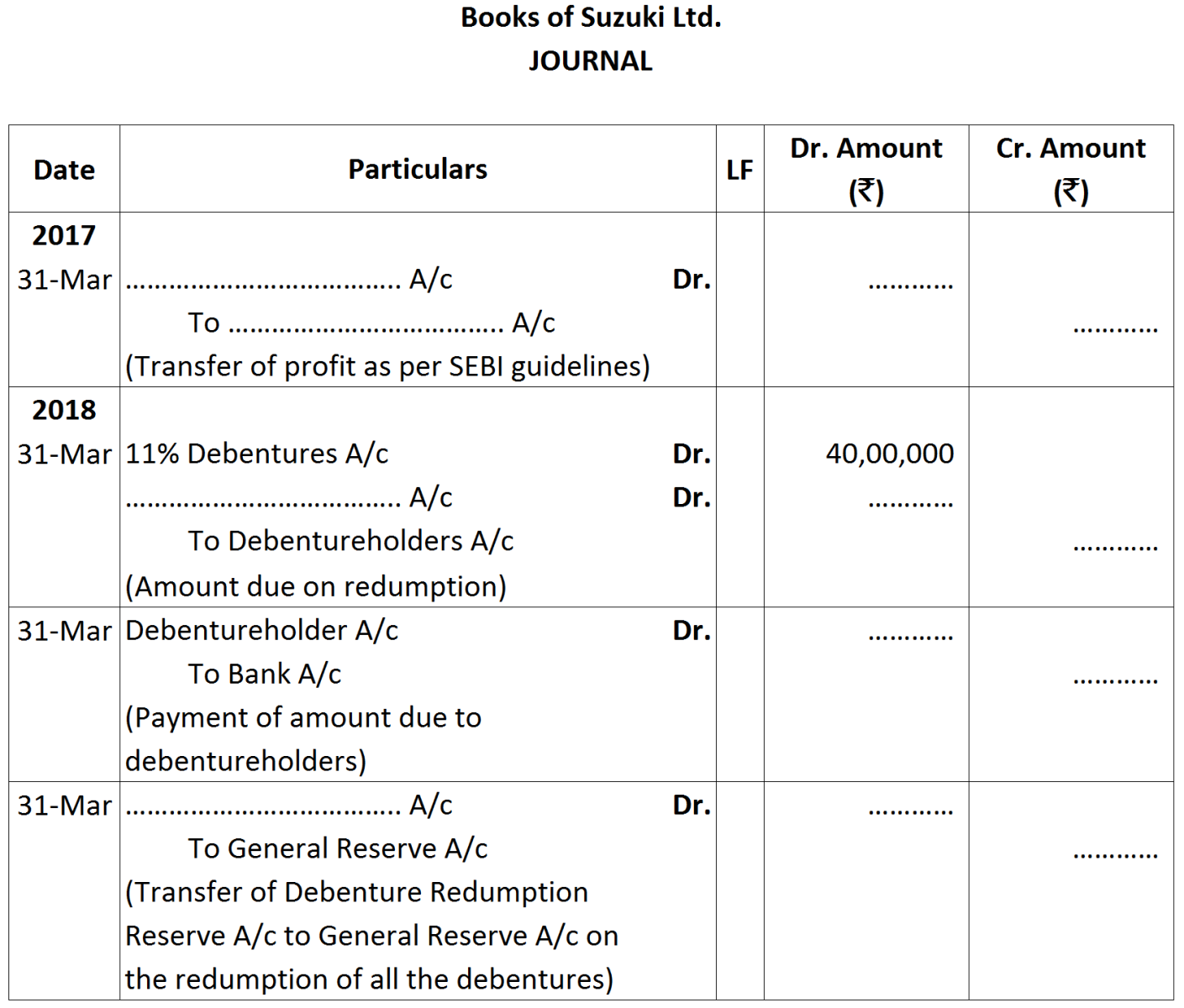
Suzuki Ltd. redeemed its entire 11% debentures at a premium of 10% out of profit on 31st March, 2018. Fill in the missing figure in the following journal entries:
How is analysis of financial statements important to Government Authorities?
State which of the following would result in inflow, outflow or no flow of cash:
  1. A long-term loan from a bank.
  2. Repayment of long-term loan.
  3. Payment of interest on loan.
  4. Conversion of debentures into preference shares.
  5. Interest received on investments.
  6. Interest due on debentures.
  7. Receipt of accrued interest.
  8. Purchase of securities of a company.
  9. Buy-back of Equity Shares.
  10. Purchase of Goodwill.
  11. Goodwill written off.
  12. Patents written off.