Question
From the following diode circuit. Which diode in forward biased condition

Answer

Get the step-by-step solution for this question inside the Vidyadip app.

Get the answer in the app

Need a full question paper?

Generate a complete, print-ready paper with questions like this in minutes — across 16+ boards, with answer keys.

Start Generating Free

Similar questions

A spring mass system (mass $m$, spring constant $\mathrm{k}$ and natural length $l$ ) rest in equilibrium on a horizontal disc. The free end of the spring is fixed at the centre of the disc. If the disc together with spring mass system, rotates about it's axis with an angular velocity $\omega,\left(\mathrm{k} > > \mathrm{m} \omega^{2}\right)$ the relative change in the length of the spring is best given by the option
The radionuclide $^{11} _6 C$ dacays by $\beta ^+$ emission.

Given that $m(^{11} _{6} C )$ = $11.01143\  u $

 $m(^{11} _{5} B )$ = $11.009305 \ u$

$m_e = 0.000548\  u, 1u = 931.5 \  MeV/c^2$

The $Q-$ value of this decay process is :-
A stone is projected at angle $30^{\circ}$ to the horizontal. The ratio of kinetic energy of the stone at point of projection to its kinetic energy at the highest point of flight will be :
Which of the following statement is true
Which one of the following statements is not true about the motion of a projectile?
A cell of internal resistance $r$ is connected across an external resistance $n r$. Then the ratio of the terminal voltage to the emf of the cell is
Two solids $A$  and $ B$  float in water. It is observed that $A$  floats with $\frac{1}{2}$ of its body immersed in water and $ B$  floats with $\frac{1}{4}$ of its volume above the water level. The ratio of the density of $ A$  to that of $B$  is
A particle of mass $ 0.3 \,kg$ is subjected to a force $F = - kx$ with $k = 15\,N/m.$ What will be its initial acceleration if it is released from a point $20 \,cm$ away from the origin .......... $m/s^2$
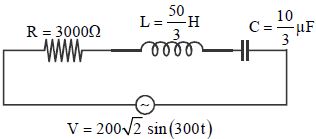
The average power consumed by the given circuit is......$W$
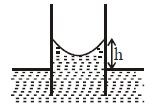
Two vertical parallel plates are partially submerged in water. The distance between plate is equal to $d$. Water rises due to surface tension $T$, the width of plate is $l$, and contact angle of water with glass is $0^o$. Find the force of attraction between the plates.