Question
From the following informations calculate:
  1. Current Ratio.
  2. Quick Ratio.
  3. Operating Ratio.
  4. Gross Profit Ratio.
 
 
Current Assets
70,000
Operating Expenses
40,000
Current Liabilities
35,000
Revenue from Operations
1,20,000
Inventory
30,000
Cost of Revenue from Operations
60,000

Answer

  1. Current Ratio $=\frac{\text{Current Assets}}{\text{Current Liabilities}}$
Current Assets $=\frac{ ₹ \ 70,000}{ ₹ \ 35,000}=2:1$
  1. Quick Ratio $=\frac{\text{Liquid Assets}}{\text{Current Liabilities}}$
$=\frac{\text{Current Assets - Inventory}}{\text{Current Liabilities}}$

$=\frac{ ₹ \ 70,000 - ₹ \ 30,000}{ ₹ \ 35,000}$

$=\frac{ ₹ \ 40,000} { ₹ \ 35,000}=1.14:1$
  1. Operating Ratio $=\frac{\text{Cost of Revenue from Operations + Operating Expenses}}{\text{Net Revenue from Operations}}\times100$
$=\frac{ ₹ \ 60,000 +₹\ 40,000 }{ ₹ \ 1,20,000}\times100$

$=\frac{ ₹ \ 1,00,000}{ ₹ \ 1,20,000}\times100= 83.33\%$
  1. Gross Profit Ratio $=\frac{\text{Gross Profit}}{\text{Net Revenue from Operations}}\times100$
$= \frac{\text{Revenue from Operations - Cost of Revenue from Operations}}{\text{Net Revenue from Operations}}\times100$

$=\frac{ ₹ \ 1,20,000- ₹ \ 60,000}{ ₹ \ 1,20,000}\times100$

$=\frac{ ₹ \ 60,000}{ ₹ \ 1,20,000}\times100=50\%$

Need a full question paper?

Generate a complete, print-ready paper with questions like this in minutes — across 16+ boards, with answer keys.

Start Generating Free

Similar questions

X Ltd. issued 5,000, 12% Debentures of ₹ 100 each at a premium of ₹ 5 payable as follows:
On Application
₹ 30 (including premium)
On Allotment
₹ 40
On Ist and Final Call
The balance amount
Applications were received for 6,000 debentures and allotment was made pro-rata to all applicants. All the moneys were duly received. Pass necessary journal entries.
Calculate:
  1. Operating Profit Ratio.
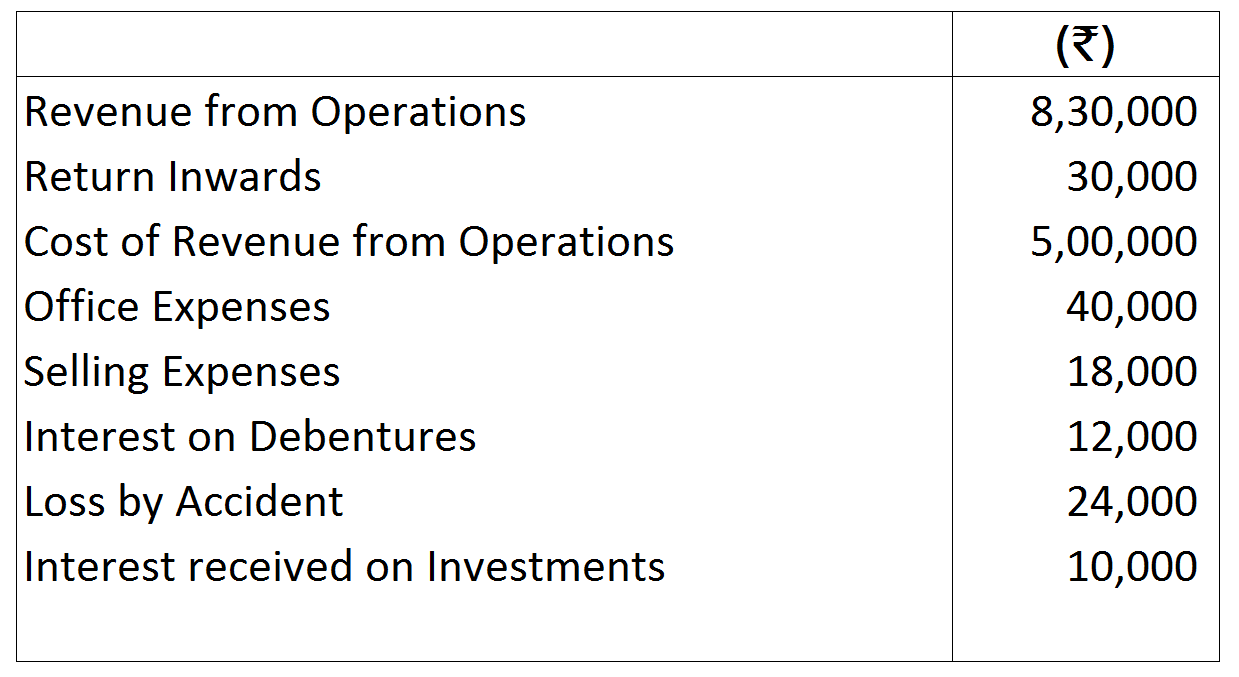
  2. Net Profit Ratio from the following.
​​​​​​​
On $1^{st}$ April, $2014$, KK Ltd. invited applications for issuing $5,000 10\%$ debentures of ₹ $1,000$ each at a discount of $6\%$. These debentures were repayable at the end of $3$rd year at a premium of $10\%$. Applications for $6,000$ debentures were received and the debentures were allotted on pro-rata basis to all the applicants. Excess money received with applications was refunded.
The directors decided to transfer the minimum amount to Debenture Redemption Reserve on $31.3.2016$. On $1.4.2016$, the company invested the necessary amount in $9\%$ bank fixed deposit as per the provisions of the Companies Act, $2013$. Tax was deducted at source by bank on interest @ $10\%$ p.a.
Pass the necessary journal entries for issue and redemption of debentures. Ignore entries relating to writing off loss on issue of debentures and interest paid on debentures.
Vikram Ltd. issued 50,000 shares of ₹ 10 each at a premium of ₹ 1 per share payable as follows:
₹ 3 on Application
₹ 4 on Allotment (including premium)
₹ 2 on Ist Call
Balance when required
Applications were received for 46,000 shares and all of these were accepted. Directors did not make the final call. A shareholder holding 800 shares did not pay the amount due on first call. The shares were forfeited and re-issued at ₹ 7 per share, ₹ 8 per share paid.
Pass Cash Book and Journal Entries.
Amit holds 100 shares of ₹ 10 each on which he has paid ₹ 1 per share as application money. Bimal holds 200 shares of ₹ 10 each on which he has paid ₹ 1 and ₹ 2 per share as application and allotment money, respectively. Chetan holds 300 shares of ₹ 10 each and has paid ₹ 1 on application, ₹ 2 on allotment and ₹ 3 for the first call. They all fail to pay their arrears and the second call of ₹ 2 per share and the directors, therefore, forfeited their shares. The shares are reissued subsequently for ₹ 11 per share as fully paid. Journalise the transactions.
A company was registered with an authorised capital of ₹ 10,00,000 divided into 7,500 Equity Shares of ₹ 100 each and, 2,500 Preference Shares of ₹ 100 each. 1,000 Equity and 500; 9% Preference Shares were offered to public on the following terms — Equity Shares payable ₹ 10 on application, ₹ 40 on allotment and the balance in two calls of ₹ 25 each. Preference Shares are payable ₹ 25 on application, ₹ 25 on allotment and ₹ 50 on first and final call. All the shares were applied for and allotted. Amount due was duly received. Prepare Cash Book and pass necessary journal entries to record the above issue of shares and show how the Share Capital will appear in the Balance Sheet.
Nitro Paints Ltd. invited applications for issuing 1,60,000 equity shares of ₹ 10 each at a premium of ₹ 3 per share.
The amount was payable as follow:
On Application - ₹ 6 per share (including premium ₹ 1),
On Allotment - ₹ 3 per share (including premium ₹ 1),
The balance - On First and Final call
Applications for 1,80,000 shares were received. Applications for 10,000 shares were rejected and pro rata allotment was made to the remaining applicants. Over payment received on application was adjusted towards sums due on allotment. All calls were made and were duly received except allotment and final call from Aditya who was allotted 3,200 shares. His shares were forfeited. Half of the forfeited shares were reissued for ₹ 43,000 as fully paid-up.
Pass necessary journal entries for the above transactions in the books of Nitro Paints Ltd.
What journal entry shall you pass when shares are issued by a Public Limited Co on premium?
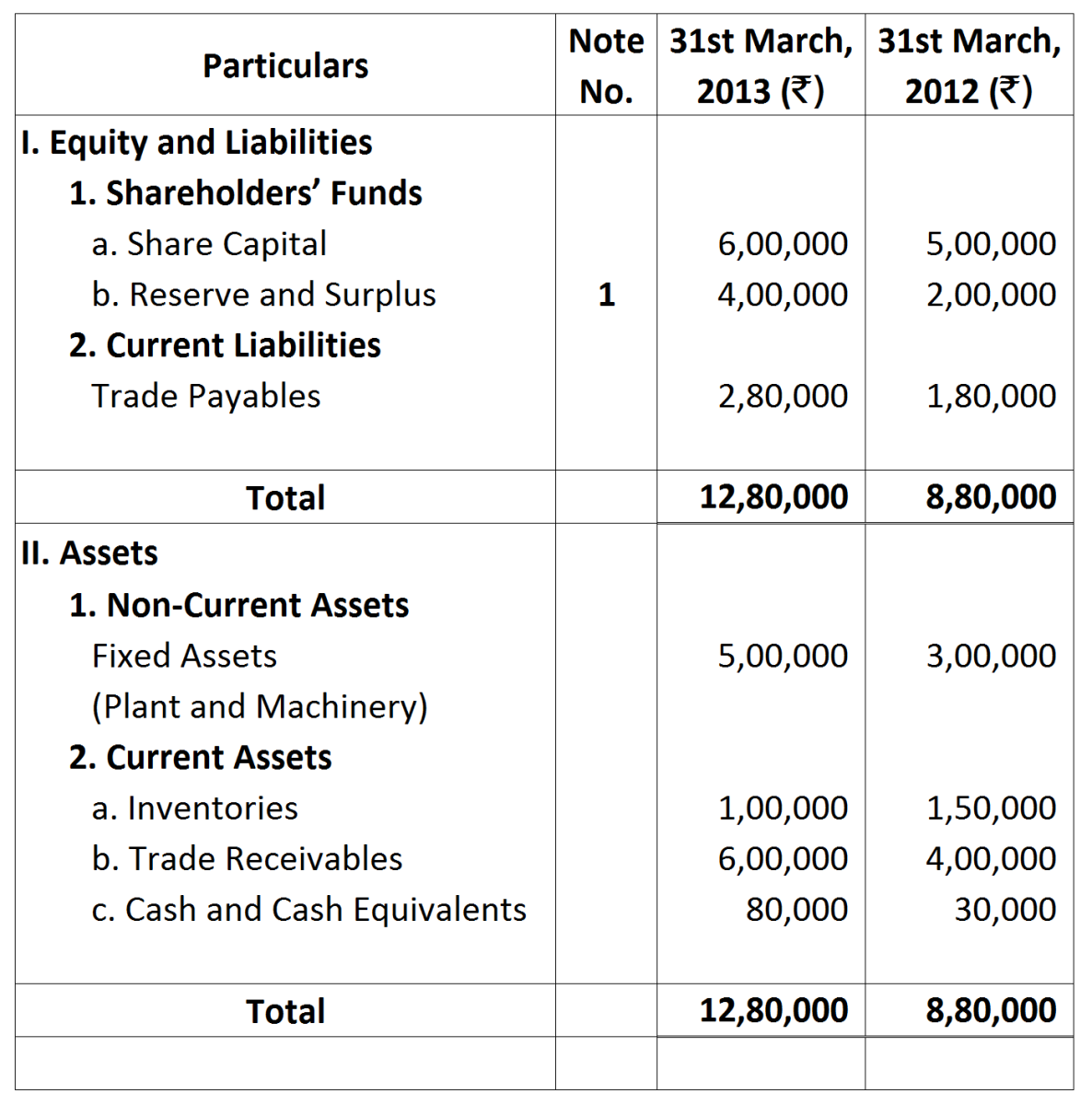
Prepare Cash Flow Statement from the following Balance Sheet:
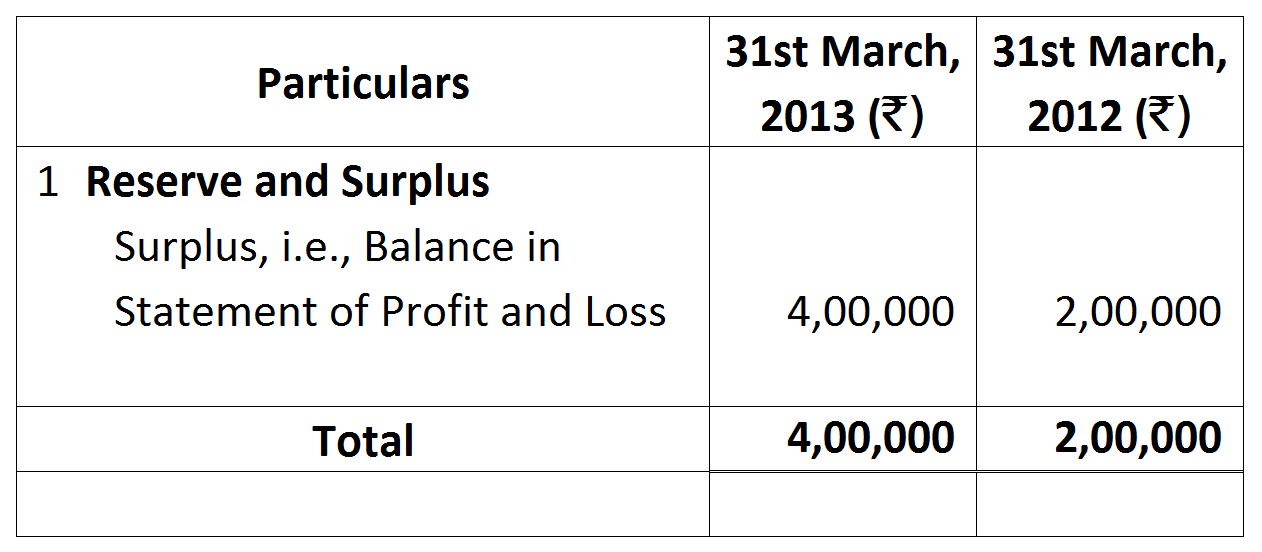
Notes to Accounts:
Additional Information:
  1. An old machinery having book value of ₹ 50,000 was sold for ₹ 60,000.
  2. Depreciation provided on Machinery during the year was ₹ 30,000.
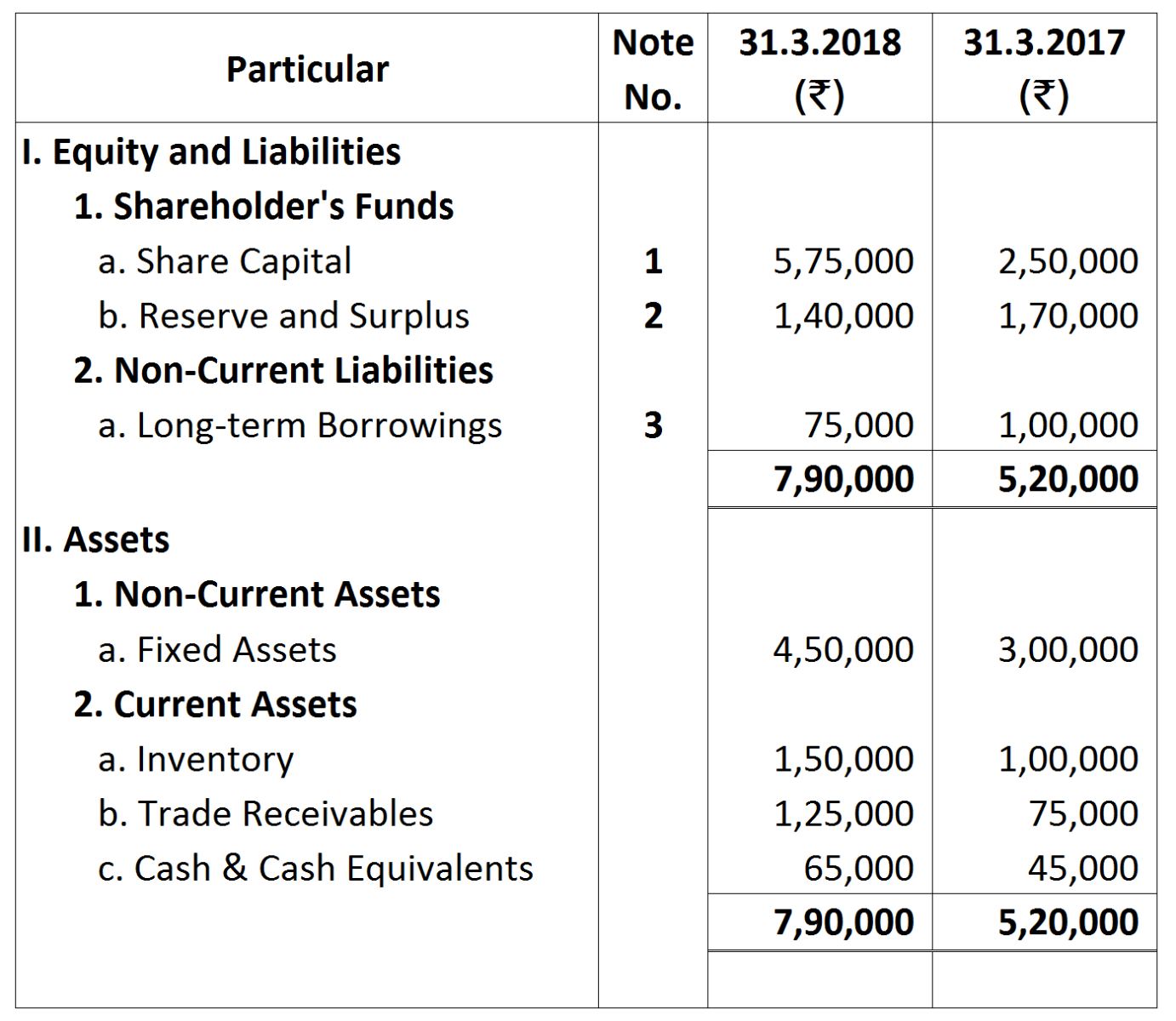
From the following Balance Sheets of Som Ltd. as at 31-3-2018 and 31-3-2017 prepare a Cash Flow Statement:
Notes:

Additional Information:
  1. During the year, a machine costing ₹ 70,000 was sold for ₹ 15,000.
  2. Interim Dividend paid on equity share capital during the year ₹ 24,000.