Question
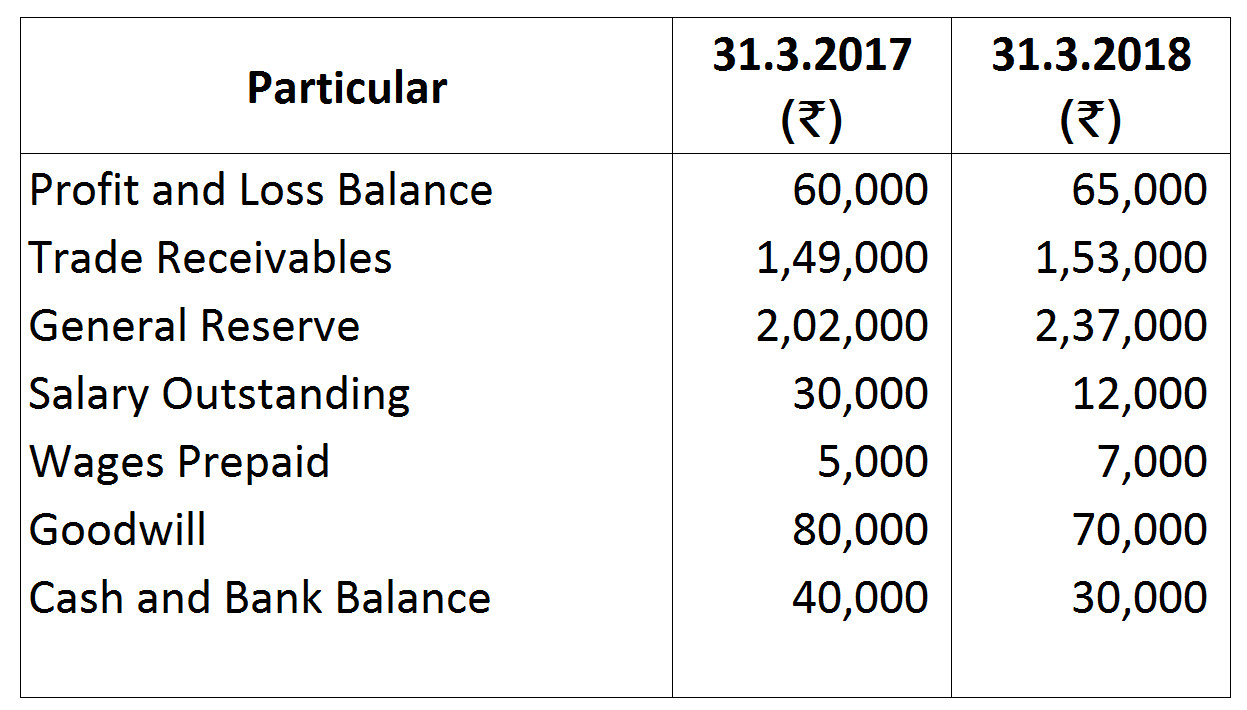
From the following particulars determine the Closing Debtors:
Answer

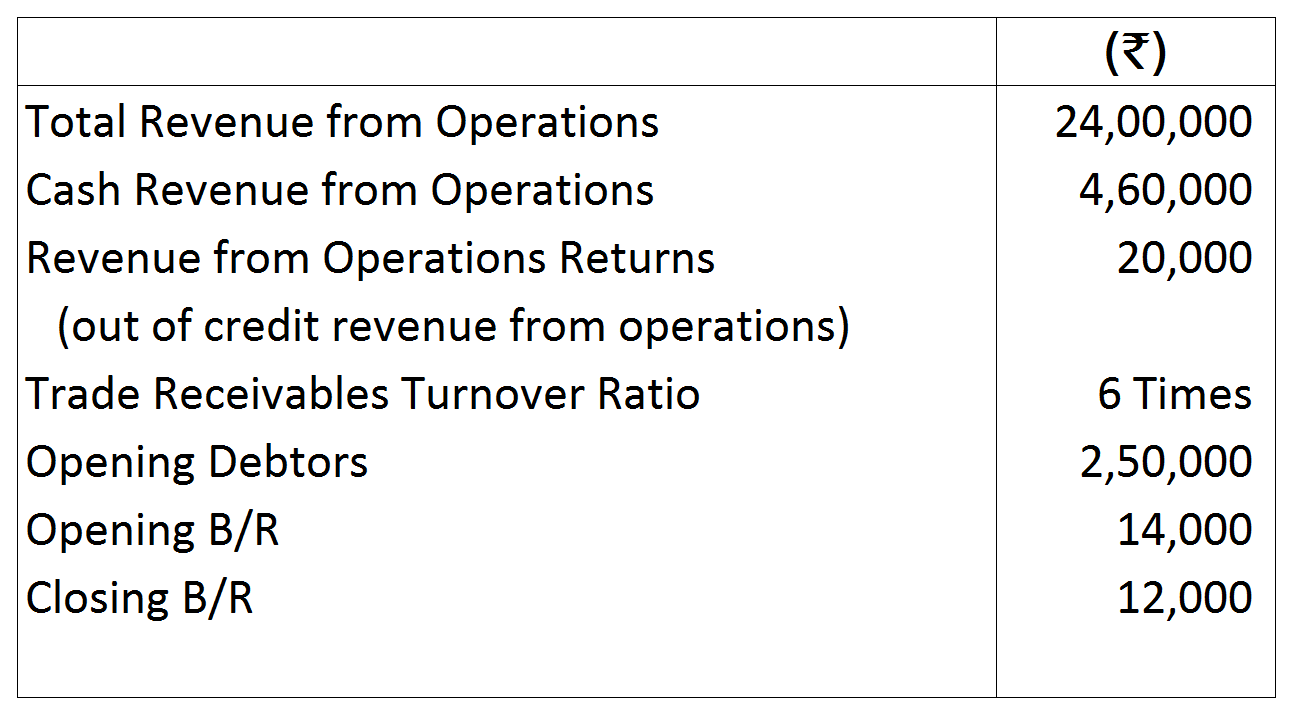
Trade Receivables Turnover Ratio $=\frac{\text{Net Credit Revenue from Operations}}{\text{Average Debtors &B/R}}$
$6\ \text{(Given)}=\frac{\text{Total Revenue from Operations}\\ {-{\text{}}\text{ Cash Revenue from Operations}}\\{-{\text{}}\text{Credit Revenue from Operations Returns}}}{\text{Average Debtors & B/R}}$
$6=\frac{(₹\ 24,00,000 - ₹\ 4,60,000- ₹\ 20,000 )}{\text{Average Debtors &B/R}}$
Average Debtors & B/R $=\frac{₹\ 19,20,000}{6}= ₹\ 3,20,000 $
Total of Opening Debtors & B/R and Closing Debtors & B/R = ₹ 3,20,000 × 2 = ₹ 6,40,000
or Opening Debtors + Opening B/R + Closing Debtors + Closing B/R = ₹ 6,40,000
= ₹ 2,50,000 + ₹ 14,000 + Closing Debtors + ₹ 12,000 = ₹ 6,40,000
Closing Debtors = ₹ 6,40,000 - ₹ 2,50,000 - ₹ 14,000 - ₹ 12,000
= ₹ 3,64,000

Need a full question paper?

Generate a complete, print-ready paper with questions like this in minutes — across 16+ boards, with answer keys.
Start Generating Free

Similar questions

Given the following information:
From the following information, calculate:
  1. Gross Profit Ratio.
  2. Inventory Turnover Ratio.
Current Assets of a Company are ₹ 3,06,000 and its Current ratio is 1.8 Afterwards, it issued new equity shares off ₹ 1,00,000. Calculate the revised current ratio.
Record necessary journal entries in the books of the Company in following case for redemption of 1,000, 12% Debentures of ₹ 10 each issued at par:
  1. Debentures redeemed at par by conversion into 12% Preference Shares of ₹ 100 each,
  2. Debentures redeemed at a premium of 10% by conversion into Equity Share issued at par,
  3. Debentures redeemed at a premium of 10% by conversion into Equity Shares issued at a premium of 25%.
What do you understand by analysis and interpretation of financial statements? Discuss their importance.
From the following information, calculate Cash Flow from Investing Activities:
Particulars
31st March, 2018 ₹
31st March, 2017 ₹
Machinery (At cost) 5,50,000 5,00,000
Accumulated Depreciation 1,70,000 1,00,000
During the year, a machinery costing ₹ 50,000 (accumulated depreciation₹ 20,000) was sold for ₹ 26,000.
Calculate Inventory Turnover Ratio from the data given below:
Inventory in the beginning of the year ₹ 10,000
Inventory at the end of the year ₹ 5,000
Carriage ₹ 2,500
Revenue from Operations ₹ 50,000
Purchases ₹ 25,000
On the basis of the following information, calculate:
  1. Debt-Equity Ratio and
  2. Working Capital Turnover Ratio.
Information:
Net Sales 60,00,000
Cost of goods sold 45,00,000
Other current assets 11,00,000
Current liabilities 4,00,000
Paid up share capital 6,00,000
6% Debentures 3,00,000
9% Loan 1,00,000
Debenture Redemption Reserve 2,00,000
Closing Stock 1,00,000
From the following information, calculate Cash Flow from Investing Activities:
Particulars
31st March, 2018 ₹
31st March, 2017 ₹
Investment in 10% Debentures
Land and Building
10,00,000
15,00,000
5,00,000
9,00,000
Additional Information:
  1. Half of the investments held in the beginning of the year were sold at 10% profit.
  2. Depreciation on Land and Building was ₹ 50,000 for the year.
  3. Interest received on investments ₹ 75,000.
Calculate 'Cash from Operating activities' from the following figures: